30 Cacao Seeds for a Rabbit

The firecrackers went on until well after midnight.

Leave the hotel around 8:00 this morning, the streets are deserted, warm on the sunny side but the air is still cool. Retrace our steps from last night looking for a recommended cafe for breakfast but they’re not open until 11:00 today. Make our way back towards the Bagel Barn, fingers crossed. On the way we pass the communal laundry areas, we’ve seen a few of these around Guatemala – even when there is a washing machine at home these are used because they are a place to meet and gossip, no-one has started washing yet today however.

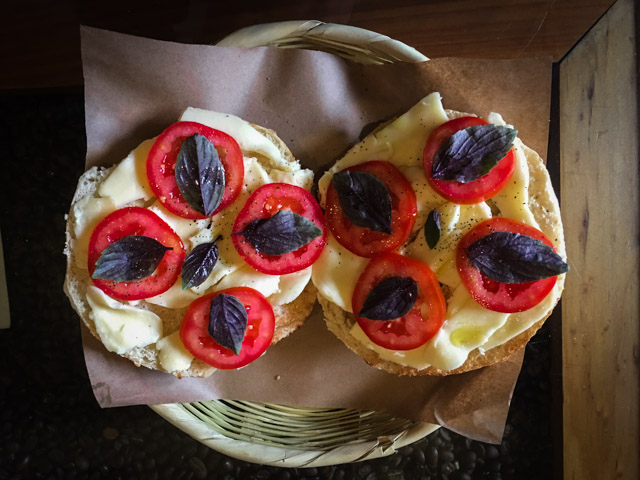
Bagel Barn is open – a grilled cheese bagel, spinach and banana smoothie and a strong coffee are a good antidote to last night’s drinks.

Next stop is the Merced Convent ruins, like most of the ruins here this suffered in the 18th Century earthquakes. It was built to withstand strong tremors but still wasn’t strong enough for those huge quakes. The first floor is still standing but the upper stories are almost all missing.

Buy a few gifts and souvenirs in a big tourist shop, they have their own version of Maximon the Mayan god in a shed in the courtyard; the only worshipper today is a local cat.

Most of the sites in town are closed so we end up gazing at ruins through railings.

Sightseeing isn’t working today so we try a few activities instead. First up is chocolate making. Cacao trees were originally from South America but chocolate itself developed from a drink produced in what is now Guatemala as early as 1900BC, it was a drink of Olmec Kings and Priests. The Aztecs took the idea from the Mayans and had to transport the beans from Guatemala overland manually, the beans were used as a currency; among other things 30 beans would buy you a rabbit. The Aztec word Cacahuatl put off the Spanish who changed the word to Chocolade and started exporting the beans back home. Chocolate was soon popular all over Europe. In 1910, William Cadbury convinced a number of British and American producers to stop using beans from plantations that used slaves.

Our class started with a history lesson and then moved onto more practical demonstrations. The cacao beans have to be roasted, dried and fermented before being used, this was done for us but we then ground up the cacao nibs by hand in a pestle and mortar and used the resulting cacao liquor – it is slightly alcoholic  – to make Mayan style chocolate drink, Spanish hot chocolate and chocolate tea from the bean shells. They’re all very tasty, rich and savoury and a long way from the chocolate bars we’re used to. Finally, we used some ready melted dark chocolate to make our own sweets with a number of fillings to choose from: chilli, orange, mint, cardamom among others.

The chocolates will be ready in two hours, in the meantime it’s time for our Salsa lesson. Our teacher is called Victor Hugo. He is very patient and guides us though some basic steps, he finishes with a short demonstration that we video so we can practice later – maybe.

Just time to collect the chocolates before meeting our new guide and group of travelling companions.

Everywhere is quiet in town, we have craft beers from the Antigua Brewing Company to bid farewell to the town and Guatemala. Tomorrow we leave at 4:00am for Honduras.


Chicken Buses

We appreciated the benefits of a good night’s sleep today; nine hours last night which made up for a few shorter nights. Tasty breakfast of pitta and hummus, smoothie and coffee, watching hummingbirds feeding on the flowers in the restaurant garden.

8:30 departure back to Antigua – it might take 3, or 4 or 5 hours. We’re stuck behind “chicken” buses for the first fifteen minutes. These buses are old American school buses which are now used as public transport. They are everywhere, they pour out clouds of black smoke, they can go quite quickly when they choose and they appear to rule the roads. They also come in many different colours, they have names painted down the side and they are all slightly different.

The traffic is on our side and we get to Antigua before mid-day and hit the streets to see the sites. The town is busy with visitors, Guatemalan and foreigners, all here to party tonight.

We wander a few random streets, grab a coffee and try Ta’Cools for lunch, share a very good vegetarian taco and a couple of hibiscus juices to cool down. Antigua is 2,000m above sea level so the air is quite cool but the sun is strong so it feels hot. We walk round the bus station to have a close look at some more buses.

Back to the hotel for a quick shower before the big night ahead, by 5pm the central square is already filling up, there’s a band playing outside the cathedral and a strange mixture of people on stilts, people with very large heads and an avocado dancing below them.

We try an ice cream, pineapple and chilli, very nice.

The Galeria de Arte is open until 7pm so we have a look round. The paintings and sculptures are mainly from Central America, they are exuberant and colourful and reflect the personality of the people and the landscapes we’ve seen. It feels like art that has developed away from most European influences, we don’t like it all but it’s refreshing to see so many new styles.

The volcanoes around the town out on a good show for New Year’s Eve, throwing out smoke into the sunset.

Enough culture, it’s time to party – Cafe No Se is one of the coolest bars I’ve ever seen, it’s very dark, candle-lit, there are small doors off the main room leading to little corners to sit in – one has a sign over the door, which is about 4 feet high, saying Mescal bar – minimum 2 shots. There are images of Maximon, the Mayan god we saw yesterday, also a poster saying “Trump eres un pendejo” – ‘Trump is an @***hole’. The soundtrack is a mixture of sixties rock and blues. We have a couple of Mescal Mules and toast the New Year that has just turned in London, very tasty.

Back on the street we head back to the hotel to meet the group for our last night meal, distracted by a ruined, floodlit church, it’s slowly being restored, mass is just beginning so it’s clearly active. The Central Square is now much more active, more music and dancing – a few people appear to be dressed in fireworks which makes some of the crowd move rather quickly.

My ears are ringing from a fire cracker that explodes in the street very close to us.

We have a quick drink with the group then head off to try another bar we spotted earlier – Por Que No? – we can just get to the bar to get a drink but have to drink it on the pavement, the bar is tiny and very atmospheric. We get chatting to a brother and sister from Singapore and get some tips for later, much later, in our trip.

Happy New Year!

“It’s too windy, we’re not going there today”

I still can’t decide whether Andy was having me on or not. He got up and had a shower, and told me I should have one, I’d feel better, and the water was hot. The water wasn’t hot.

Being high up in the village means that we were at the mercy of the high winds. Dogs barked continuously during the night, and cockerels crowed incessantly. Despite all this, we slept fairly well.

At 7am, we went up to the kitchen. Christiana was busy preparing our breakfast: omelettes, frijoles (black beans) and tortillas. Very welcome. All washed down with a cup of very sweet black coffee. Felipe, her husband, joined us. He is a fireman and starting at 8am, he was starting a 24 hour shift. We talked about the news (a lot of bad stuff happened in Guatemala City overnight). At 7.30am, we thanked them for their hospitality and got back to our meeting point.
Homestays are a good thing. How else can you genuinely experience another culture? We got to have dinner and breakfast with a Mayan family. And we talked a little about what is being done to preserve the culture. But my they’re awkward affairs!

On our way to Panajachel, we stopped at a viewpoint. The three volcanoes over the Atitlán lake are stunning.

After leaving our bags at the hotel (our room wasn’t yet ready), we walked to a recommended travel agent and asked for a tour of the three most important towns across the lake. He told us that today he could take us to three different towns, as there was too much wind over the lake which would make for a bumpy ride. Although we really wanted to go to ‘our’ three towns, we had no other options for the day so we said yes. Down at the jetty, he directed us to a boat and told us that it will take us to the towns we’re interested in. What happened there?

The ride over to the first town is indeed a little bumpy.

San Juan La Laguna is a very pretty town, with smart coffee shops and a women’s cooperative which sadly we didn’t have time to visit (we were only ashore for 40 mins). The town is renowned for its weaving.

I didn’t like our next town (San Pedro La Laguna) so much. It felt a little more trashy with many hostels and cheap looking restaurants (and not in a good way). Not surprisingly, there are many backpackers about. We climbed to the top of a church for an overview of the town and the lake. In another church, we witnessed a woman praying and kneeling her way to the altar, with another woman making her way back to the church entrance, praying and kneeling backwards.

Our third stop is where things got very interesting. Santiago Atitlán is the largest of the lake communities and here, the people are Tz’utujil Mayans (which means different colour outfits and a different language).

Upon landing, we got into a tuk tuk and followed Maja and her partner, a couple from San Francisco we got chatting to on the boat, as we were planning to visit the same places.

Our first stop was the Catholic Church, where we visited the shrine of the Roman Catholic Priest Stanley Rother who was assassinated by right-wing death squads on 28 July 1981. His crime was to fight for the rights of the indigenous population. He translated the New Testament into and held mass in Tz’utujil.

Santiago Atitlán is also the home to Maximón (mah-shee-mohn). To find him, our tuk tuk went deeper into narrow alleyways and stopped outside an even smaller pathway, which led us to someone’s house.

Maximón is believed to be a form of the pre-Columbian Maya god Mam, blended with influences from Spanish Catholicism. He moves home every year on 8 May (after Semana Santa) and we are told that his care is rotated amongst ten houses in town (he is looked after 24 hours a day).

From Wikipedia: “his shrine is always attended by two or more people, called Cofrades, who serve for a full year to care for him in the Cofradia and keep the altar and sacred items in order. Shamans come daily to do rituals on behalf of their clients.

The Cofrades also receive visitors, accept offerings which are used to maintain and enact the ancient customs, celebrations, and rituals. Worshipers offer money, spirits and cigars or cigarettes, candles, incense, and prayers to gain his favor in exchange for good health, good crops, and marriage counseling, amongst other favors. Maximon almost always has a lit cigarette or cigar in its mouth, and in some places, his mouth is formed to allow the attendants to give him spirits to drink. These offerings are a way of “feeding,” giving life, and gratitude to Mam.”

Yes, he smokes and drinks rum.

Our last stop was the Posada de Santiago where we had lunch. A recommendation from Maja’s partner as he had a connection with the owner. The food was very good and it’s a shame we were rushed but we needed to be back at the jetty for 2.15pm.

The ride back to Panajachel was indeed a bumpy one. Back in town, we checked out an art gallery and a photography museum. And I indulge in a spot of shopping.

Back in our rooms with a couple of beers. We need a good night sleep tonight.

Colourful and Vibrant Chichi

We’re up early to have a quick look round the town before it gets going. We’re lucky to get a look in another ruined church while it’s being tidied up from a wedding yesterday; when we pass it a few minutes later, it is shut. Some nuns are out for their morning stroll; people looking for breakfast. We settle on Bagel Barn – they claim to have the best bagels in the country, they’re certainly very good.

We’re on the road again at 9:00 – a 3.5 hour drive to Chichicastenango ahead of us. Chichicastenango is a small town in the hills, it’s main attraction is a large market which sells all sorts of items in traditional cloths and colours, primarily for tourists, as well as clothes and food for locals.

The first site we visit is the multi-coloured graveyard, nothing sombre about this place – everything is painted in clashing primary colours.

We walk through the market place. The stalls are piled high with bags, trousers, ipad covers, ponchos, belts and many other things in bright traditonal patterns.

We stop for a quick lunch – it takes ages to come and has ham instead of cheese in the omelette so we just make do with the side dish of guacamole.

There are two churches in the corner of the market square, these are built on the site of older Mayan temples. Mayan people still enact rituals on the church steps which look like they may be remains of the older buildings. They wave large incense burners and chant incantations to who knows which gods.

Tonight we’re staying with a family in San Jorge la Laguna. It’s recommended we buy some food for them from the supermarket – so we do!

We only have three hours in Chichicastenango – not nearly enough, we’re soon on the way to San Jorge with a quick stop to watch the sunset over Lake Atitlan on the way.

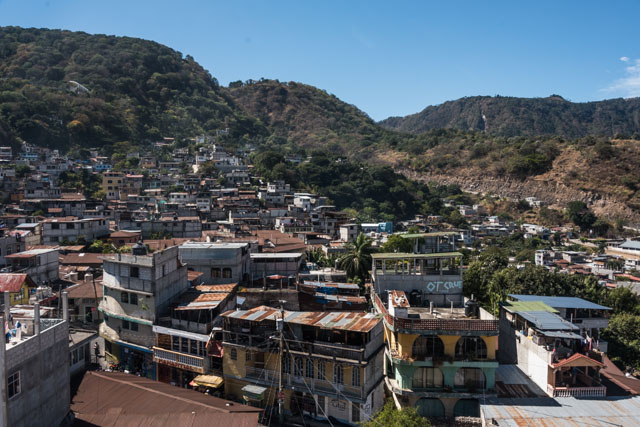
San Jorge is compact town of 4,000 cascading down the hillside towards the lake, it has one church and one bar, we pay a brief visit to both.

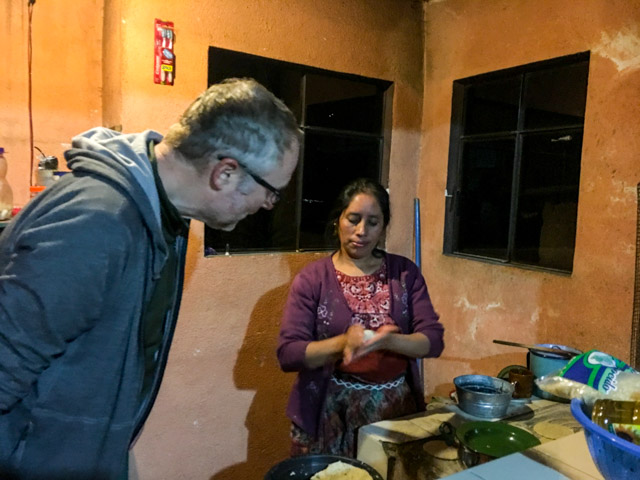
We’re introduced to Christiana, she takes us back to her house and shows us to our room. She is quiet but friendly and helpful, she shows me how to make tortillas, I try it but it isn’t as easy as it looks – two of my three make it to the table, one is discretely discarded.

Dinner is simple but tasty, rice, potatoes and green beans. There is also a very hot homemade chilli sauce – Christiana and her son are amused by the large spoonfuls we take, it’s hot but bearable.

None of the family speak much English, their first language is Kaqchiquel, one of 22 Mayan languages still spoken in Guatemala. They also speak some Spanish which they use to communicate with speakers of the other languages. Conversation is tricky but we get by between us with a bit of Spanish, a phrase book and the Google Translate app.

That’s not a cappuccino

6:30 Start 7:00 REM

8:00 Wilco

9:00 Breakfast

10:00 Belle and Sebastian

11:00 Floating Points

12:00 Laura Marling

13:00 Unknown Mortal Orchestra

14:00 Wolf Alice

Early start today for a long drive to Antigua. The alarm goes off at 5:00, we’re departing at 6:00. To add to our enjoyment there is no electricity and very little water – hot or cold – so we wash minimally, pack and dress in the dark.

We manage to get everything together and we’re in reception at 5:50, just in time for a quick coffee before the water taxi takes us to the bus.

We’re on the road by 6:30, if we’re lucky we’ll be in Antigua by 2:00pm – it all depends on the roadworks and the traffic. The first few hours are uneventful, we stop for a basic but tasty breakfast of eggs, beans and cheese. As we get into the hills the scenery gets more interesting, deep green valleys below us, the hilltops in the clouds.

Things slow down as we approach Guatemala City, we aren’t stopping here, from what we see of it this isnt a bad thing. It’s a big and sprawling city of about 5m people with only a few high rise buildings downtown. We cross high over a valley, single story houses cascade down the sides, looking very much like Rio’s favelas.

We’re quite lucky with the traffic and arrive at our hotel soon after 2pm. Antigua is immediately attractive, cobbled streets, low colourful buildings.

Antigua was the third Conquistador capital of Guatemala, it served as the seat of Government from 1543 until a number of major earthquakes in the 18th Century led to the creation of a new Capital – now Guatemala City. At this time the Spanish state of Guatemala included almost all of Central America and the south of present day Mexico. The city is surrounded by volcanos, one of which is still active.

We walk the streets randomly for an hour, it’s attractive but very busy. It’s only a short drive from the capital and many people are still on holiday after Christmas. Through a gateway there are some floats for an Easter parade, including some fairly gruesome flailing and crucifixion scenes. We stop for a drink, I order a cappucino and watch in dismay as the barista adds instant coffee and powdered milk to a cup, pours in hot water then adds cream from a can on top. I tell him it’s not a cappuccino, i.e. espresso, hot milk. He insists it is – I pay the 80p and leave it on the counter. Down the street there’s a much better cafe, no problems with the macchiato there.

Walk further and come across a beautiful ruined church, damaged by the 17th Century earthquakes, I would love to get my tripod inside but unfortunately it’s locked because its unsafe.

Return to the hotel for a shower before dinner.

Genuine Ray Ban, 45 Quetzales

There was heavy thunder throughout the night, but apart from the one that shook our bungalow, it didn’t stop us from sleeping well.

We grabbed mugs of coffee and watched the sunrise over the lake. Back in the bungalow, we observed our colony of bats, nesting in the eves.

Breakfast of champions. Cazuela Ko Bán – eggs poached in ranchero sauce, topped with cheese and chopped cilantro over tortillas with more cheese in a casserole, with fresh fruit on the side. Andy had the Fruta de la Ruta Maya – an assortment of fresh fruit with lime, honey, yogurt and granola.

We’d chartered a boat for the day amongst eleven of us, and departed at 9am for Livingston.

Our first stop was the San Felipe fort on Lake Izabal. The small Spanish colonial fort was built as a defence against British pirates when the area was an important shipping route, and later served as a prison.

The Rio Dulce (‘Sweet River’) flows out of Lake Izabal to the Caribbean Coast. There are many posh yachts – it’s a popular place to moor your boat during the hurricane season.

Next, we toured bird island – many cormorants, pelicans, egrets, and other flying things. On the lake, men were fishing in dugout canoes.

We went down a narrow channel, and saw water lilies, mangroves, and a few houses. Local woman and children in dugout canoes rush to our boat to sell their wares.

We stopped at a natural hot spring. Opting out of this one, we sat with coffees and ginger biscuits.

We sped through a canyon, dense vegetation on each side and orangey iguanas sunbathing at the top of trees.

Livingston is a Garifuna town at the mouth of the Rio Dulce. It is the only Garifuna community in Guatemala, with Belize having a larger population. There are no roads to Livingston, the town can only be reached by boat.

The town has a great vibe and we spend a couple of hours wandering the streets. There is great street art, street food stalls, pigs roaming the streets, fish drying in the sun and the Caribbean sea at the end of the streets on the east side of town, as well as a few shops and restaurants catering for tourists.

We tried the tapado Garifuna at Happy Fish Restaurant and it’s delicious.The ‘real’ version has a coconut cream base with fish, crab and shrimp; ours was made with banana, plantain and vegetables.

There is just enough time to shop. I broke my sunglasses on Christmas Day and patched them up with sellotape, but with the humidity and the sweat, this was always going to be a short-term fix. I tried various pairs of ‘Ray Ban’ sunglasses in a shop and the price of the ones which fitted me best drop by 5 quetzales for no reason. I probably could have haggled them down further, but these people are trying to make a living. After all, I can’t complain; £4 for ‘genuine’ Ray Ban is a bargain.

The return journey goes quickly. With hills in the background, and low vegetation on the foreground, there is so much sky and the clouds are spectacular.

There is time to catch up with our journals with a beer before dinner.

Early start tomorrow, with a seven to nine hour journey by private bus to Antigua.

Hot showers!

We had a surprisingly decent night in our tent after all with exotic animal noises from the jungle lulling us to sleep.

Up at 6am for a quick cold shower to wash off the sweat and bug spray.

We had been tempted to do the Tikal sunrise tour, but woke up to heavy mist and felt justified in our decision to give it a miss. Heavy clouds accompanied us all day, which surprised us a little. We had such a clear sky last night, the stars were truly amazing.

We left Tikal at 7am and drove back to El Renate for a hearty breakfast, and then on to Flores. The town is on an island and although it’s quite touristic, it has genuine charm. Sadly, we both realised too late that we didn’t take a broad view of it.

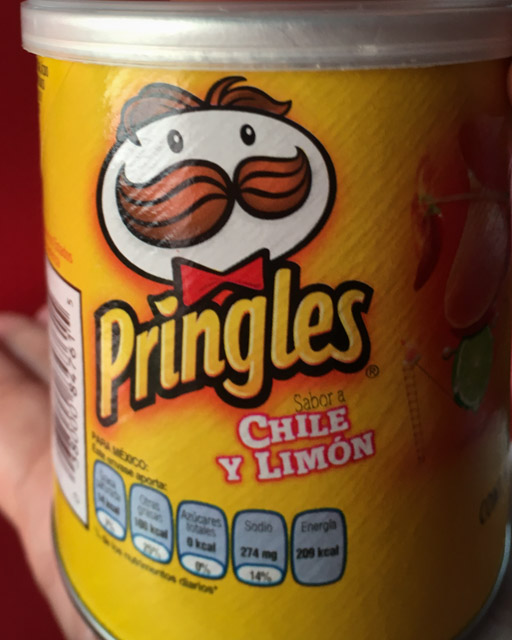
A long day in the bus allowed us to try local snacks and another type of chilli crisps.

All day, the sun played hide and seek with us. It would be sunny when we got out of the bus to stretch our legs and there would be a heavy downpour whenever we got back on the bus to continue with our journey. Mostly, these were short showers, but the rain set in early evening and is now steady.

The landscape was pretty much lush hills in the distance, and agricultural fields in the foreground. Palm tree and banana plantations mostly. It was sad to see men spraying fields with pesticides. All the farm work is manual, with men carrying machetes everywhere.

It is visibly poorer here, and I’m guessing that most people rely on subsistence farming for a living. There is quite a bit of rubbish along the road, and in the communities.

Along the way, we passed men on horseback, wearing cowboy hats. We passed shops selling saddles and all things horse related.

We stopped in Rio Dulce to pick up a picnic for lunch and felt like queen and king of the castle with our tortillas, avocado and cheese (a type of salty halloumi made in Guatemala). And after a short drive, we arrived at the Agua Caliente.

The waterfalls come over limestone formations. To get to the waterfall, you enter a natural pool. At that end, the water is cool; under the waterfall, the water is hot as it would be if you turned the hot tap on to medium to high. I ventured in and kept going from cold to hot. Great fun.

Back in Rio Dulce, we took a boat taxi for the short journey to our hotel. We have a nice bungalow; very spacious and the bathroom has a great hot shower. We’re happy and clean for five minutes, and then it’s bug spray time.

It’s Christmas Day, it must be Guatemala

We’re leaving for Guatemala this morning, only two places are open so we have breakfast in one and coffee in another. Breakfast at a street stall is a very tasty burrito of cheese and beans, Florence has extra eggs with hers. Coffee is dark and strong, we chat to a local while we drink it, he teaches us a few words of Mayan – unfortunately his vocabulary doesn’t extend to Happy Christmas, we give him a task to learn it later in the day when he’s having lunch with his family.

We’re on our way by 9:00, it’s a short drive to the border and a very uneventful crossing. We have to pay a small fee to leave Belize and a small fee to enter Guatemala.

It’s an hour drive to our lunch stop, the land is very green with cultivation, it’s low-lying with a lot of water around.

Lunch is functional, nice salad and fruit juice, not so good cheese sandwiches. This isn’t our best Christmas lunch.

Phone our respective families, it’s good to talk to them all after nearly a month away, hard not to mention the sunshine, blue sky and temperature when they’re enjoying grey skies and rain – ‘but at least it’s mild’.

After lunch we’re on our way to Tikal, one of the largest Mayan sites in the region.
Tikal was at its peak between 200AD and 850AD although it started much earlier than this, probably from Mayans migrating from highland areas in the North when crops failed there for a number of years.

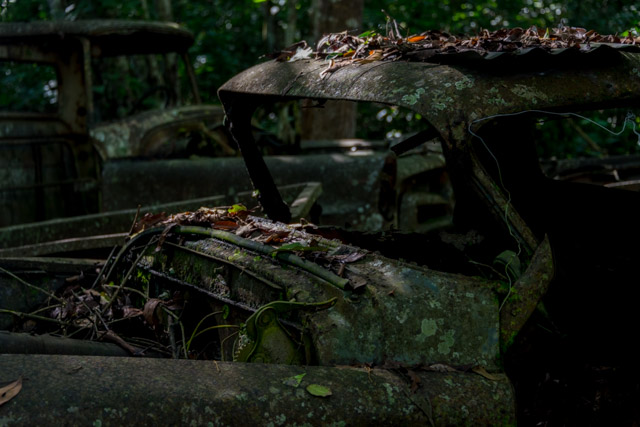
We start the visit with a walk through the jungle, we come across some vehicles left behind by an archaeological survey in the early 1970s. These are being slowly claimed by the jungle, rusting and adopting the green of the jungle.

Other sites we’ve visited had the feel of a town, Tikal is much larger, the major structures are further apart and although only 10% is excavated so far there are many more large plazas and buildings.

We climb the tallest temple – the archaeologists call it Temple IV – it’s about 230 feet high, even then the top only just reaches above the jungle canopy. A few other structures poke through the trees but it’s mainly a sea of green jungle as far as we can see. It’s the ideal place for our Christmas postcard image.

Next is my favourite part of the site, El Mundo Perdido – The Lost World. This is a group of smaller buildings which have been partially uncovered but mainly left to the jungle, there are trees and ferns of all shapes and sizes around them and the sun only breaks through in small patches highlighting parts of the stone.

We pass more temples and plazas until we reach the main square. This has the iconic Temple of the Grand Jaguar at one end, the other sides are made up of more temples and other structures – generally noble houses or administrative. From the top of one of them we watch the sun set into the jungle.

We only had two and a half hours to explore, we could have spent days – maybe next time.

We’re camping just outside the site tonight, not sure why as there is a hotel nearby. We go to the hotel restaurant for a Christmas Margarita and a tasty salad. And we drink close to a litre of water each.