Caracol – the most amazing Mayan site you’ve never heard of

We had a free day ahead of us and at least five options to pick from, all options you’d want to do.

We settled on a day trip to Caracol, and set off at 7am. It was just the two of us, our guide Erhard and Mario, our guide/driver for the day.

Here’s the checklist we were given when we booked the trip:

  • Good footwear
  • Water
  • Snacks
  • Bug spray
  • Towel
  • Swimwear
  • Sunscreen
  • Cameras
  • Change of clothes

Caracol is 40 kms away from San Ignacio, and after 40 mins or so, we left the road and travelled on a potholed dirt track for about 1.5 hours, through nature reserves. Initially, the vegetation was dense, a direct result of the limestone in the ground and then sparse pine trees as the ground changed to clay.

Our first stop was the picturesque Rio Frio Cave. A river runs through the cave, and once inside, you can see both ends as well as great limestone formations.

We registered at the army checkpoint before we were able to proceed to Caracol, still a good hour away. The army patrol the site daily; we’re very close to the border and it seems that this is not a happy border and that the relationship between the two countries is strained. In fact, only yesterday a local paper reported that Guatemala was encroaching on Belize’s territorial waters.

Caracol covered approximately 200 square kilometers. It is now thought that it was one of the most important regional political centres of the Maya Lowlands during the Classic Period.

Only 10% is excavated so far, but the Caracol Archaeological Project (ongoing every year since 1985) spends three months at the site, digging in, collating their research and then refilling the site so nature can take over once again (the best way to protect the buildings).

We climbed the Caana (“sky-palace”), and were surrounded by lush vegetation. We’re truly in the middle of nowhere. Fun fact: the Caana is still to this day the highest man-made structure in the whole of Belize. The second highest building is… El Castillo at Xunantunich. Yes, that’s right. In the last two days we’ve climbed both highest buildings in the country.

The feeling is that of coming across a lost city.

Walking about, we stumbled across pieces of pottery. Some of the un-excavated buildings are grassy mounds with trees growing on top of them. In some cases, you can just about see building foundations.

We saw a massive spider in one of the burial chambers; tasted wild coriander; touched some sticky sap from a glue tree and it smelled like incense and came across beautiful butterflies and two aracari toucans.

And the best bit? Apart from the two of us, and our two guides, there were nine other tourists at the site. It’s not an easy place to get to.

We wandered happily for just over three hours, and too soon, it was time to return to our car for lunch. The rum punch flowed freely.

After all that exploration, our short stay at Rio On Pools was most welcome. We just had time to cool off in the various pools; with the most beautiful background of pine forests and waterfalls.

The most perfect day.

** I really wish you could all be here… right now, on the town square outside our window we’re being treated to a local Christmas Eve party. Someone’s got hold of the microphone and is singing to his heart’s content. It’s so atrocious we can’t stop laughing. **

Merry Christmas.

A Day of Extremes

We set the alarm early so we would have time to get fry jacks for breakfast. I love them! They’re cheap, filling and very tasty. My light beignet was filled with eggs and cheese this morning. We ate them by the sea, with the sound of the wind in the palm trees above us.
We got the 8am ferry to Belize City. Thankfully, we had cover today to protect us from the wind and the sun.
The taxi to the bus station took us through the town. We’ve haven’t really had a chance to explore it, but I think we’ve seen enough. It’s not very attractive, and it has a reputation for being dangerous.

Belize has its fair share of issues. The unemployment rate is high (10.1%), the prevalence of HIV/AIDS is the highest in Central America (2.1%), and in recent years, it has become a major transit route for illegal drugs.

Belize is quite a melting pot. From the Garifuna (responsible for the distinctly Afro-Caribbean vibe of Caye Caulker), Mayans, Creoles to the Mestizos and Mennonites.

Andy did get a glimpse of the swing bridge and got giddily excited. The bridge was build in Liverpool in 1922 and was installed in 1923. It is the oldest swing bridge in Central America and the one of the few manually operated swing bridges in the world still in use.

Our journey to San Ignacio took about two hours, stopping briefly in Belmopan – the capital. We travelled in one of those old American school bus. There was plenty to look at along the way, and the driver treated us to a great playlist. We passed Mennonite farms. The Mennonites speak German and form 4% of the population; they are mostly farmers and crafstmen and were described to us as living a life similar to the Amish).

I didn’t know what to expect of San Ignacio. It turns out to be an ugly town, built principally around tourism; there are many activities to do around here.

We made our way to the market for lunch. We ate pupusas, a thick handmade corn tortilla with beans and cheese and served with curtido (a lightly fermented cabbage slaw with red chillies and vinegar). Delicious!

Back to the bus station, we got a bus towards Benque and got off after twenty minutes. We crossed the Mopan river via a hand-cranked ferry, and then walked up a hill for about a mile.

Our hard work was rewarded when we got to the Xunantunich ruins. The site peaked around AD 600 to AD 650 and was abandoned due to an unknown violent event in approximately AD 750.

The climb to El Castillo rewarded us with gorgeous views over lush green distant hills and into neighbouring Guatemala (our next destination). In fact, the views were that good that we climbed up to the very top twice, without too much effort (are we getting fitter?).

Very little of the site is excavated. The usual story sadly. There is money for excavation, but not for restoration and maintenance.

It’s a stunning site. Compact yet extremely attractive.


Two Panty Rippers Please

Yesterday was about being under the waves, today was about being over them. We arrived bright and early at 8:15 for our taxi to the ‘airport’ for a scenic flight over the ocean to be told bad news – the plane’s broken, it developed a strange noise yesterday afternoon and had been grounded. Fortunately they managed to get us onto a flight with another airline in the afternoon.

To assuage our disappointment, we had a wholesome breakfast – fried jacks are a large savoury doughnut stuffed with any combination of eggs, beans, cheese, ham or chicken – plus the obligatory chilli sauce.

We walked around the streets for a while – they are colourful and lively. Stopped for a coffee then walked along the sea front as far as we could go, this is the quiet end of town, no bars, just waterfront hotels with their own jetties.

We returned to the hotel for a bit to cool off then back out for a juice and some shopping – replenishing our t-shirt stocks.

It’s soon time for our flights, the taxi to the airport is a 6 seat golf buggy, transport on the island is foot, bike or buggies. The plane is not much more than a 6 seat golf-buggy with wings. We are given silver class boarding passes – it’s like playing at airports, two minutes later the ground crew take the boarding passes off us. It’s the first time I’ve ever got in a plane and turned left but business class it isn’t, my knees don’t fit behind the pilot’s seat in front of me and my head is touching the ceiling. The windows are big however.

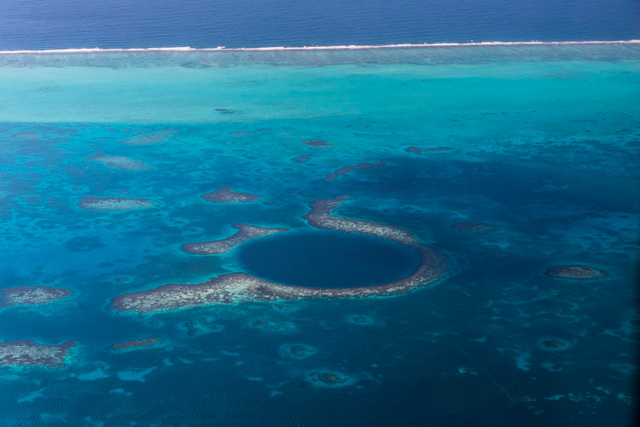
We’re soon airborne and climbing over the sea, the town is on my side, Florence has the reef and open ocean on hers. There is a good aerial view of the channel we snorkelled in yesterday. We turn out over the sea and head towards the Blue Hole 43 miles out to sea.

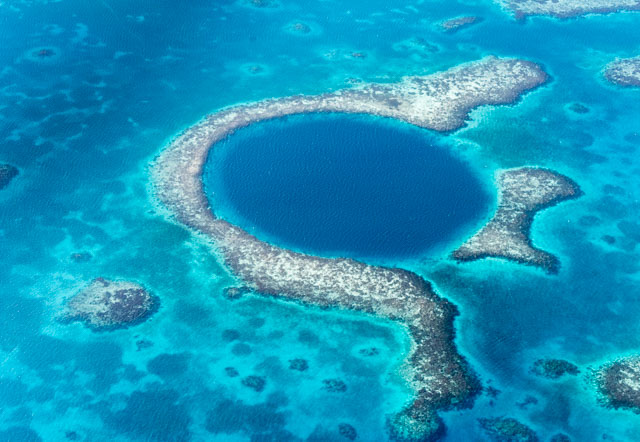
The Blue Hole is a 400 foot deep cave in the floor of an atoll, approximately 900 feet across. It was formed above sea level, like the cenotes we’ve previously seen in Yucatan and was subsequently submerged by rises in sea level.

From above, the hole is deep rich blue, contrasting with the turquoises of the surrounding shallow water. We circle a few times in each direction at different altitudes to give everyone a good look. It’s an amazing site, far better in reality than images can prepare you for, this was one of the things I was looking forward to the most on the trip and it wasn’t a disappointment. Too soon we’re done and move on to look at a ship wrecked on the edge of the atoll then back to the airport.

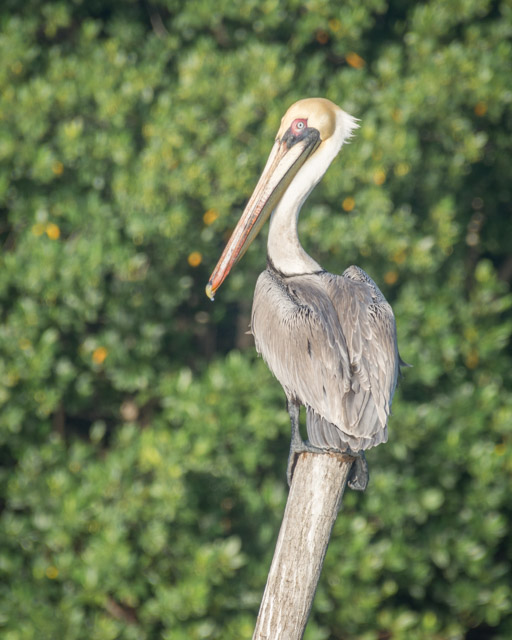
We’re back just in time to watch the sun set into the sea while pelicans fly around the small fishing harbour on the west side of the island.

Florence’s nerves needed calming after the flight. When we arrived in Belize we asked our driver what cocktails we should order on Caye Caulker, his immediate reply was Panty Rippers – so we do. These are fresh pineapple juice and coconut rum, in a waterfront bar watching the last of the light on the Caribbean through the Palm trees, the bar has swings instead of bar stools. It’s all as good as it sounds.


Swimming with Sharks

Started the day with a healthy breakfast of fruit and muesli, smoothie and coffee – preparation for an active day ahead. Today was all about what’s under the water – snorkelling on the reef.

This is the second longest living reef after the Great Barrier Reef. It runs 560 miles from Cancun to Honduras, including the  whole length of Belize. Charles Darwin called it the most remarkable site in the West Indies and it was also a favourite of Jacques Cousteau.

We spent the day with StressLess tours. Captain Keith runs everything, assisted by Dylan and Gazza. It’s a 30 minute speed boat ride out to the first site. The sky is blue, the sun is shining, the sea is a rich turquoise blue. On the horizon, there is a white line of waves from the Caribbean breaking on the edge of the reef.

All the sites we visit are in the Hol Chan Marine reserve, this is an area set up to protect the marine life and environment. There are reserve staff on the water monitoring what is happening, our guides ensure that everything is done correctly; when a single piece of rubbish blows overboard they dive in to retrieve it.

The water is warm and shallow; no need for our Cornwall wetsuits here. Under the surface there are fish of every colour everywhere as well as corals of many shapes and sizes.

The second site is known as Shark and Ray alley – for good reason. When we anchor there are dark shades in the water below, these are Nurse sharks, harmless to us, they live in a diet of shrimps, shellfish and occasionally coral. Sting Rays glide along the bottom.

The third site is a channel through the reef which lets a strong current through, it’s about 15m deep in the middle. Different varieties of fish and coral live here.

The final site is a barge that sank in the sixties and has now been totally claimed by the reef, inhabited by fish and coral.

We return to the dock through the Split, a gap right through the island created by a large hurricane in 1961 that killed 100s and flattened Belize City. The gap was bridged by a causeway until another hurricane tore it away, it’s currently under repair.

We ended another fine day with a rum punch and a plate of pasta made by an Italian from Verona. His restaurant is closed on Thursdays and Fridays. When we asked him why, he told us he plays in a band on these nights and doesn’t trust anyone else to make the pasta and run the place.

Welcome to Belize

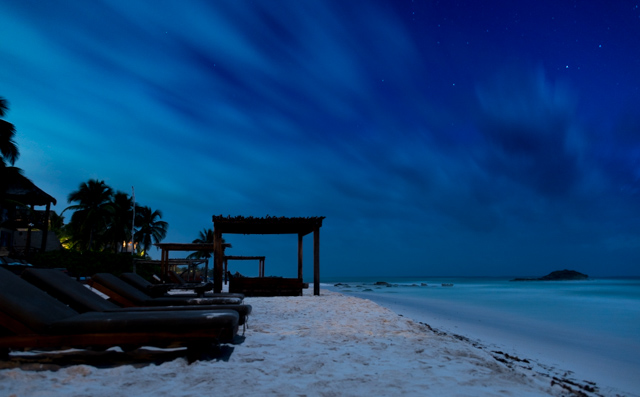
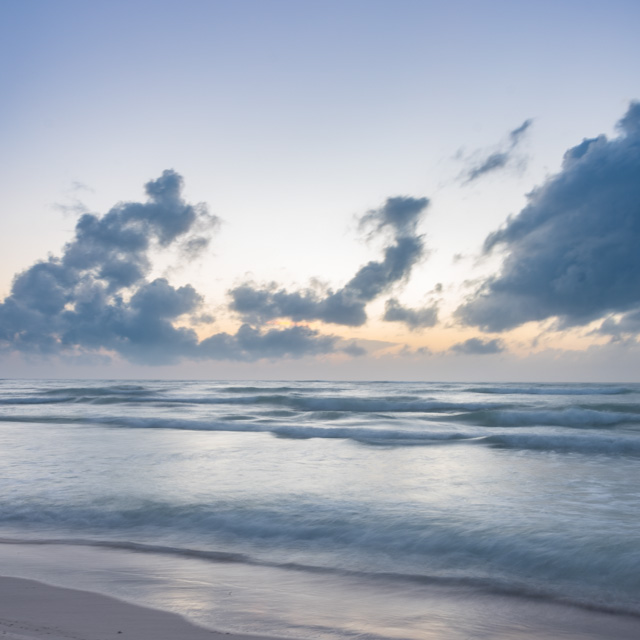
The alarm went off at 6am today, a full two hours before our scheduled departure. We had the beach to ourselves, and the sunrise was beautiful. Slowly going from moon light to sunshine; all in very delicate colours.

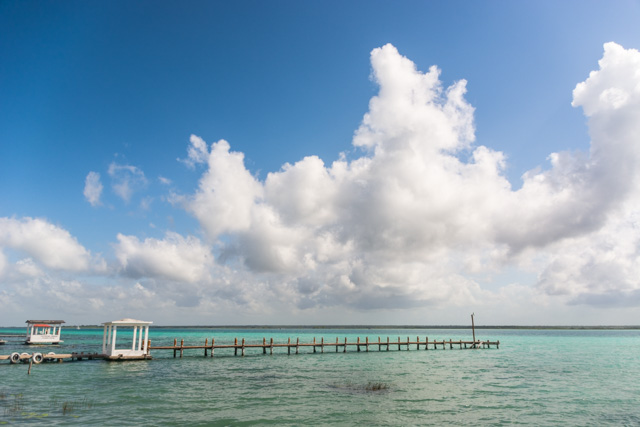
We drove to Bacalar, about 2.5 hours away from Tulum, where we had breakfast and where I dipped my toes into the Laguna Azul – so named because you can see up to seven shades of blue; we saw four.

We’ve thoroughly enjoyed our time in Mexico. It’s been a revelation to Andy who can’t wait to come back. The colours, the people, the music, the sights… and the food. Oh… the food.

There is obviously another side to Mexico. Everyone’s is an entrepreneur. If you want it; someone is selling it. There’s also a lot of child labour; and we’ve been approached by very young children.

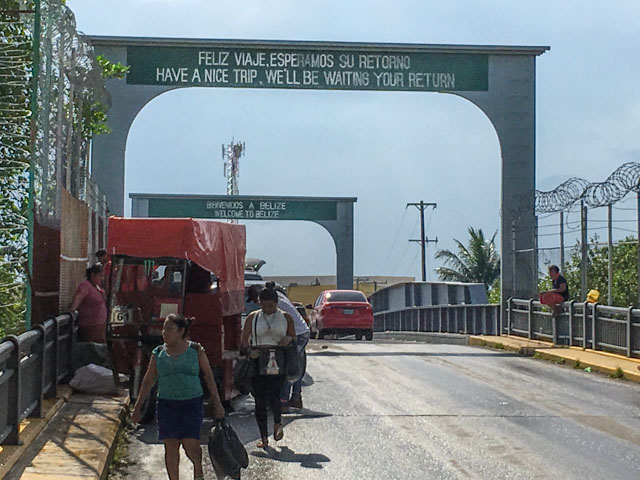
We drove on to Chetumal. Our border crossing saw me scoring a small victory. There is an exit tax of $30 per person. I had read up that this is normally included in your flight tickets and got Andy to print a detailed copy of our tickets. It worked. We saved $60 (note to self: researching the trip ahead of time pays off).

Time to go.

Hasta luego Mexico! You have fed us well.

We crossed into Belize by foot.

Straight away, it felt very different. The buildings are lower and more spaced out. Most of them are ramshackle; the poverty seems more apparent. Our driver, Henry, told us that the country gets many grants from the E.U. It used to be a British colony, so they speak English here and patois. The Queen’s on the bank notes.

We raced two thirds of the country in just over two hours. We got to Belize City just too late to get the 5pm ferry to Caye Caulker. On the way, we saw lorries full of sugar cane, and many of those old fashioned yellow schoolbuses from the USA.

Our forty minute journey on the Belize Express ferry was breezy and speedy. Unfortunately, it got dark very quickly so we weren’t able to appreciate the scenery. That will be a suprise for tomorrow.

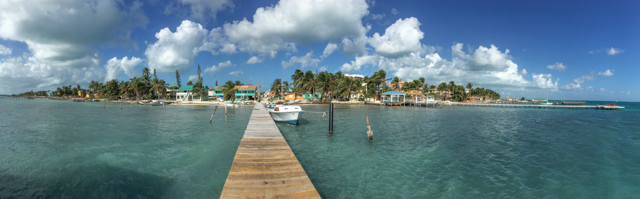
As soon as we landed on Caye Caulker, we could tell we were somewhere special. The place has a real laid-back Caribbean feel. A little breeze in the air; no motorised vehicles; colour everywhere… and extremely friendly people. And in Marie Sharp’s red habenero pepper sauce, I think I have finally met my match.