Every Breath You Take

All too soon it was our last morning in Berlin.

We continued our exploration of the East, taking a metro, a train and a bus to Hohenschönhause Prison. The prison was the main Stasi centre for internment, interrogation and research into surveillance methods. It used to be a factory away from the city centre; it had road and rail links. The area was left completely blank on maps of the city at the time; no one knew it was there.

We arrived around 10:00. We had a bit of time to look round the courtyard before our guided tour – in English – began at 10:30. Our guide was a historian who had studied human rights and became interested in what had happened in the prison. She was extremely knowledgeable and informative.

We began with a short film that explained a bit of background to the prison. The tour proper began with the oldest parts – here the cells were very basic; below ground level and the only light was from small windows at the top of the walls, which had frosted glass bricks so nothing could be seen. The basement had a couple of cells that were no more than cupboards where a person could just stand up. People were put in there for days. There were also water torture cells, the same as we’d seen used by the KGB in the Baltic Republics a few years ago. A prisoner would be left to stand in ice-cold water in a freezing, damp cell for days on end. As the DDR became more paranoid, the number of prisoners grew, the level of surveillance and the amount of interrogation increased. The newer cellblocks were a little more pleasant, but not much. We saw a delivery lorry, marked as a bakery delivery but used to carry prisoners. Those inside couldn’t see out, long circuitous routes would be taken to ensure no one knew where they were taken. There was a hospital on the site, prisoners would be driven there from their cells, taking an hour long drive around the city so they thought they were elsewhere.

As well as the usual catalogue of physical tortures, the Stasi put a lot of effort into perfecting techniques to unsettle prisoners mentally. Favourites included choosing a room with décor as close as possible to that in the home of the prisoner (same wallpaper) and offering the prisoner a drink and ensuring that their favourite brand was on hand without asking them what that was… just to show that they knew a lot about you. Even the layout of the interrogation rooms was carefully considered. The interrogator would always have their back to the window and sit higher than the prisoner. The prisoner could see a little of the outside world to remind them what they were missing. Furniture was always angled diagonally to unsettle the prisoner. They were forced to sit on their hands – this allowed a good sweat sample to be collected from their chairs which could be used as a scent for dogs in the case of escapes. When the prison finally closed in 1991, a lot of files were opened to the public. You could find out who had denounced you to the Stasi. The guide asked us if we would have wanted to know. ‘Consider’, she said, ‘that one woman found out it was her husband – and divorced him immediately’. A young man was betrayed by his late father who would never be able to explain himself.

After a fascinating couple of hours, the tour finished with the guide reminding us that although the prison closed 25 years ago, there are still many places in the world where similar activities – and worse – are still going on and that we shouldn’t forget that.

The ‘reunion’ of Germany was seen as a very important political and social priority. The former East is still much poorer than the West. Billions of Euros are spent every year in trying to close this gap. Despite all the changes since 1989, there is nostalgia among some people – particularly the older generation – for the DDR, known as Ostalgie. The reasons include ideology, nationalism and a lost sense of social status and stability.

Our final destination was the Russian War Memorial in Treptower Park in the south east of the city. We retraced our steps to the bus and train, carrying on a few stops further to the south of the river.

Russian war memorials are never subtle but this one is larger than most. There are three in the city; this one commemorates 7,000 of the 80,000 Soviet troops that died in the Battle of Berlin. The entrance is through two huge dark marble portals. Beyond this, two lines of stone panels depict scenes of Soviet servicemen, peasants, heroes and leaders. At the end, there is a massive statue of a soldier on top of a small mound overlooking the whole site. He holds a sword and a German child, at his feet is a broken Swastika. It was a grey morning, a few people wandered around, some Russian, had they lost relatives here? Maybe just interested in their country’s history.

Against the clock, we hurried back to the apartment to collect our bags.

The journey home was quick and easy. The change in time zone and flying to City airport got us home at a good time – we’ll be doing this again, soon.

We could be heroes

Saturday 24 June 2017

I don’t think we saw or heard anyone else the whole time we were in the flat. Which was a little un-nerving. Maybe I’ve read too many cold war books. Which reminds me, if you haven’t read Stasiland yet, you should. The book and its author received a frosty reception in what was East Germany in 2004. I digress. But only a little. Things would have happened in this building where we were staying. Listening devices would have been planted in some of the flats.

We left the flat just in time to board the tram towards Mitte and especially Distrikt Coffee. We got there right on opening time (there was a queue!) and got a great breakfast (which for me may have involved a poached egg and avocado) and great coffee. The interior was trendy in a cool relaxed way and the staff was friendly.

Fortified, we walked through the atmospheric Friedhof Sophien II cemetery to the Berlin Wall Memorial. There, at Bernauer Strasse, we found a complete section of the wall still intact – with the no man’s land and one of the three remaining watchtowers. This is where the wall was first erected. In what used to be East Germany, apartment blocks were right against the wall, and early on people used to escape to West Germany through the windows. Some of these buildings were later condemned and demolished. The outdoor exhibition shows some of the successful escapes. It also tells of unsuccessful ones. People who saved their lives; people who saved others; people who took risks. The stakes were high; soldiers were under orders to shoot escapees.

The museum has more stories, some echoed the stories we’d read about the previous days. Some people had made some very difficult decisions – either informing on their friends and neighbours or helped bust escape networks.

Sure, it’s easy to be judgmental now. What would we have done in similar circumstances?

It cannot be as simple as heroes and villains.

I spent a few minutes listening to some of the audio recordings – people who had been interrogated by the Stasi; soldiers who had been told to keep guard along the wall to protect the East from the West (but soon realised that the danger was most likely internal).

There were some more uplifting stories too. Families meeting across the wall when originally the wall was just a small partition, showing off newborns or just waving to each other. Families torn apart, yet trying to keep some sense of normality.

I remember stories from my childhood. Bear with me on this one. My maternal grandmother’s brother was married to a woman. He died. She remarried. She died. Her husband remarried a younger polish woman who had escape Poland just before or just after the iron curtain. She had made the ultimate sacrifice; she’d left her family behind. Over the years, she exchanged many letters with her family – she had no doubt that her letters were censored as the ones she got from her loved ones were heavily censored. A few times, she asked for special permission to go and visit her relatives. Each request was refused. My memory is hazy here, but I think one of her later attempts was successful. She was beyond joy. My maternal grandmother kept in touch with her and her husband and this is how I know that her marriage was a happy one. She led a contented life in France. She and her husband had adopted two siblings. I remember she taught me how to pluck a chicken amongst other things.

These thoughts were circling in my head the whole time we were at the Berlin Wall Memorial. That was intense.

With mixed feelings, and some relief, we made for our next destination. Walking around Mitte was a welcome treat: the architecture is lovely and it has many cool bars, restaurants and boutique shops. Lunch at The Klub Kitchen was followed by a browse in Paper and Tea and a shop selling wrapping paper and stationery goods (a dream!). We picked up some tasty cinnamon buns from Zet fur Brot (another queue!) and returned to our sightseeing.

First on the list was one of the Alexanderplatz’s most well-known sights, the World Time Clock. Constructed in 1969, it weighs 16 tons and is 10 metres tall. The revolving cylinder has 24 time zones with the names of major cities in each zone. And, you can see the current time in each zone. I loved it.

A short walk away, we visited St Marienkirche. Only a small portion of the famous dance macabre fresco was visible, as the western portico is undergoing renovation. Very little is known about it. It’s suggested that local citizens commissioned it and that it aimed to ‘demonstrate the transience of life on earth’.

Not far from the St Marienkirche, we found larger-than-life statues of Karl Marx and Friedrich Engels, the authors of the Communist Manifesto. Another reminder that Berlin was one of the capitals of the communist world.

We took a bus to our next stop, the Room of Silence near the Brandenburg Gate. The room is located in the gate’s northern wing and it offers visitors a place to meditate, reflect and ponder in what is one of Berlin’s most touristy monuments.

We walked as close to the Reichstag as we could – big flags on display, including a huge European one. We hadn’t booked (free) tickets to enter so we made do with the monument to the Memorial to the Murdered Members of the Reichstag.

Our next memorial was the memorial to the Sinti and Roma Victims of National Socialism. Centered around a pond, it is quite understated yet peaceful.

Not memorialed out just yet, we made for the Holocaust Memorial which commemorates the six million Jewish victims of the Holocaust. It is akin to a giant field of stelae. It contains 2,711 sarcophagus-like concrete slabs, which vary in height on undulating ground. It is stunning and poignant… as long as you ignore the kids and young tourists playing hide and seek (seriously, sometimes I don’t get people!).

There was a lot to absorb and discuss, and we did that over a craft beer at Kaschk back in Mitte (all pale ale). The décor is cool, as in Scandi-it-looks-like-you’re-in-a-homemade-shed cool. During the day, they serve coffee and baked goods there.

And then we thought we’d go back to Hops & Barley because the beer is really nice there! We sat outside, and shared our table with friendly locals. Every time a new drink was purchased, a merry round of ‘prost’ rang around.

Just for one day…

Friday 23 June 2017

Quick breakfast in our apartment… going back to an old theme – breakfast tacos with scrambled eggs and avocado.

After breakfast, we headed for one of the things I’m looking forward to most in Berlin, a tour of the Hansa recording studios where David Bowie recorded Heroes.

We took a train to Potsdamer Platz metro station, with just enough time for a very nice flat white from ‘The Coffee Shop’. I managed to order in German, at least until she asked whether we wanted it to go.

The building housing the studio used to be a tradesman guild hall and dance hall. It somehow survived the wartime bombardment that flattened almost everything in the surrounding area. When David Bowie was there in 1977, the Wall was visible at the end of the street from the studio control room, inspiring the lyrics about producer Tony Visconti’s affair with a backing singer.

And the guns shot above our heads,
And we kissed, as though nothing could fall

The tour started outside with the history of the building. We then went inside to the large room on the first floor where among others, Bowie, U2, Talking Heads, Iggy Pop, R.E.M. and Depeche Mode have recorded. The tour was biased towards Depeche Mode because of the concert the previous night but we still got to hear a bit of Heroes in the room where it was created which was an emotional moment for me.

After the main room, we visited the more modern control room on the top floor which was added after Bowie was here but was used a number of times by Depeche Mode. Hearing some of the music through the studio desk at high volume was quite an experience. We also got to play a few notes on a piano used by Bowie and DM.
Our guide, Thilo, from Berlin Music Tours was very knowledgable about the studios, their history and all the bands that played there. He grew up in East Berlin and saw Depeche Mode when he was 14 when they were one of the rare western bands allowed to play in the East of the city.

After the studios we walked to the WestBerlin Cafe for lunch. Very tasty sandwiches and salads, coffee and juices and lots of books and magazines to read.

Berlin is obviously full of recent history and our next few hours were devoted to two of the major aspects of it.

Checkpoint Charlie was one of the main crossing points between East and West Berlin. On the American side, there’s a small wooden sentry hut and some sandbags – you can have your photo taken with a fake GI. On the Eastern side, there were observation towers, two sections of wall and a 50m strip – snipers alley – between them. A small exhibition explains the significance of the checkpoint and tells the story of attempted crossings, successful and otherwise. Here in October 1961, the East and West came about as close to war as ever happened, both sides had tanks pointing at each other down Friedrichstrasse, fortunately neither side really wanted it and found a way to back down.
A few hundred yards down the street, a long section of the wall remains in place but here an earlier episode of the city’s history is documented. The area housed the majority of the Third Reich government ministries, The ‘Topography of Terror’ exhibition explains the Nazis rise to power, their ways of controlling and suppressing the population and their ultimate defeat. The enormity of what happened is too large to convey in one exhibition but it does a good job of giving an overview of major events. One image of particular interest showed how the Nazis had used the 1936 Olympics for propaganda purposes; it was taken in the stadium we had been in the previous evening, apart from a new roof it remains almost as it was then.

We walked along the side of Hermann Göring’s Air Ministry building (a minimal 1940s construction) and up towards Unter Den Linden and the Brandenburg Gate. The city is very good at explaining the history everywhere and doesn’t shy away from the worst of it. We passed the location of the Nazi Reichstag opposite which was Hitler’s bunker where he shot himself in 1945. Traces of the bunker remained for a long time after the war but it has now been completely obliterated. Unter den Linden is one of the main arteries of the city, a broad multi-lane street with large grand building along its length. At the western end is the Brandenberg gate completed in 1791. The gate was just inside the Russian sector, the wall passed right behind it.

Paris Platz, immediately to the east of the gate was largely destroyed by allied bombing during World War Two. It has recently been rebuilt and is home to the French and US Embassies, a luxury hotel and a Starbucks.

We took a bus and metro back to our apartment for a quick shower before dinner. It seems that everywhere we want go in Berlin – in any direction – is about 30 minutes away.

We took a metro back to the Kreuzberg area and walked through Checkpoint Charlie again to our restaurant. Tim Raue trained at Noma which is a good enough recommendation for us. His restaurant is one of the best in the city. We chose the 6 course vegetarian tasting menu with a few German wines to help us along the way. The food was very very good – lots of interesting colours, flavours and textures, all beautifully cooked. My highlight was a desert of smoked banana, one of the best things I’ve ever eaten.

After an enjoyable three hours we walked back into the former Soviet sector and took a thirty minute metro ride home.

Where’s the revolution?

Finding that bit of the Berlin wall in Tirana makes for the perfect transition to our recent Berlin weekend break.

Our Berlin stories.

Thursday 22 June 2017

We left home fairly early and made our way to London City Airport – destination Berlin.

Flying from City was on Andy’s list. It is our nearest airport and it seems ridiculous that we never make use of it. Especially when you can be in a place like Berlin in no time (we were in the air for an hour and twenty minutes).

I guess we just needed an excuse!

We landed at Tegel and got the bus TXL to the terminus, Alexander Platz. From there, we got the metro U5 towards Hönow and got off at Frankfurter Tor.

Our airBnB apartment was located minutes from the station, in Friedrichshain. The views from the windows are exceptional, looking out towards the towers of Frankfurter Tor (formerly Stalin-Allee & Karl-Marx Allee). It doesn’t get any more East Germany than this.

The building of the apartment is a historical monument. It was built in the 50s together with the avenue Karl-Marx Allee (in the past called “Stalin Allee”). In the GDR it was a very significant and monumental avenue. The building has a special glamor of spy movies of the Cold War.” (From our host).

We dropped our bags and headed out to lunch.

The neighbourhood’s friendly and just on the right side of trendy. After a tasty lunch at Aunt Benny (a lovely place with delicious coffee, minimalistic interior and friendly service), we shopped for supplies and made our way back home.

And then it rained. Heavy rain.

So we staggered our journey back to the flat, taking regular shelter in doorways. We had checked the weather forecast so often leading up to the weekend, and rain hadn’t really been part of the agenda. Oh well.

Waiting for the rain to ease up, we finalised our itinerary for the forthcoming days. And ventured out again mid-afternoon.

We started with a walk along ‘Karl-Marx Allee’. This boulevard is allegedly 89 metres wide and two kilometres long (we’re not convinced). The style is over the top socialist classicism. The buildings are impressive.

From there, we headed towards the Spree River where we walked along the longest remaining section of the Berlin Wall (1.5 kms). And it’s incredible what memory does to you. Straight away, footage from 9 November 1989 came to mind. These were incredible scenes. History in the making, and here we were… at the wall.

The East Side Gallery – as that stretch of the wall is known – is an open-air gallery. Over 100 artists from all over the world were invited to paint a section of it. The most famous section of it all is probably “The kiss of death” with Brezhnev and Honecker kissing.

We walked across the Oberbaumbrücke – the bridge connects Friedrichshain and Kreuzberg, two districts formerly divided by the wall. Architecturally, it’s an old interesting bridge, made a lot more interesting for serving as a pedestrian crossing between East and West Berlin during the Cold War. We spent ten minutes or so walking about what was West Berlin, and retreated to the East.

Walking back towards our apartment, we stopped at Hops and Barley for a swift pint of incredible craft beer. ‘We’re coming back here, right?’, asked Andy. Oh yes. Definitely.

Dinner was a quick affair at Il Ritrovo – dead cool waiters and tasty pizzas – before our next date with history.

We made our way to the Olympiastadion, about 40 minutes away. This is very much a modern stadium now; one of the world’s top entertainment venue. But there is some murky history there.

Walking past the Olympic rings, we went in and took our seats (thankfully covered). The sky darkened. There was lightening in the sky followed by thunder. Rain fell hard.

It didn’t matter much… because when Depeche Mode are on stage, little else matters.

Now, I would happily have brought the day to an end here, but Andy asked me to expand on the concert… so here goes. The set was pretty much the same as the one we had on London a few weeks ago with just one different song. The crowd was mental, the way Depeche Mode fans are pretty much everywhere in the world apart from the UK. And consequently, the band had fun.

We got away from the stadium quickly considering how many people were about, and got a couple of metros back home. A few people in our carriage were very soggy. Soaked through. Yet everyone was buzzing.

Protecting the interests of the people

We left Ohrid at 9:30am and crossed the border within an hour. That flight from Luton is most appealing. I can see us coming back to Ohrid – taking our time exploring the back streets and the churches, taking another boat ride…

On the other side, it’s bunkermania – bunker after bunker litter the landscape and a heavy military presence. Other than that, the differences are subtle. Village life in Macedonia is not very different from village life in Albania. Failed businesses; abandoned factories; houses in ruins and many war memorials. And in the middle of all that, huge mansions under construction – from the diaspora and the mafia.

The road twisted and turned as we climbed and then descended offering us a panoramic view.

The coffee break was most welcome; macchiato of course. We stopped at a restaurant/hotel castle. Immediately, a few of us were drawn to a playful kitten – having the time of its life with a dry leaf. A woman working there brought us two more kittens and we oohed and aahed.

Back on the road, we drove through a valley. The riverbed was mostly dry. We passed vineyards. And of course, more bunkers.

We arrived back in Tirana around 1pm. We popped to the local bakery for some cheese byrek, got our clothes ready for tomorrow, packed our bags and jumped into a taxi to Bunk’Art. We arrived at the site through a 500m single track tunnel carved out of the hillside.

This was the top bunker, for the elite. The space is unbelievable. From private rooms for Hoxha and his top advisers, to a massive assembly room, a bufe, a filter room (to clean the air), a decontamination room. It felt like an underground city. What gets you after a while is how cool it is down there (the temperature is a constant 16c) and the lack of light. The exhibits varied between dry informative (facts, which may mean nothing if you don’t have at least some background to what this was all about and who was who) and fascinating video footage of Hoxha’s funeral and images of the Skanderberg square packed with people for Stalin’s funeral.

With the feeling of only having a few hours to go, we spent just over an hour there and got a taxi to take us to our next destination.

En route, we stopped at the Resurrection Cathedral. This time, we had the place all to ourselves. I was surprised at how Moorish it looked inside, architecturally.

Opposite the cathedral is the House of Leaves, Tirana’s very own museum of secret surveillance. Originally, the building was a medical clinic. It became the headquarters of the Gestapo during the Nazi occupation and then the Sigurimi (Albania’s Communist-era version of the KGB). The equipment on show was both impressive and chilling.The building was used both a listening post and place of torture. The paranoia of the government at the time is incomprehensible – creating ‘enemies’ of the state, spying on people and ensuring that nothing was beyond the reach of the State. One of the roles of Communist propaganda was about cultivating the cult of the leader.

When the right thing to do would have been to walk back to the hotel to get ready for dinner, we opted to take a walk in the opposite direction.

Fortune favours the brave.

Walking toward Mother Theresa’s square (which surprisingly doesn’t have a statue of her), we came across a few more bunkers, and… a piece of the Berlin wall. This really tied the whole trip together. Our trip to Berlin a few weeks ago (the notes of which will be coming here soon) and all we did and learnt there fitted so well with so much of what happened to this part of the Balkans.

We walked back go to the hotel, along streets we’re now very familiar with and were lucky to notice that the doors of the Pyramid were opened so we popped our heads in (they have an exhibition on urbanisation). Tirana’s grows on you, very subtly. The sun was out, people were starting to fill the public spaces.

I had read about a restaurant and very much wanted to try it for dinner – new Albania cuisine. I asked Ivan if he knew anything about it, and the next thing I know, he’d booked a table for the whole group. So, at 7pm, we got taxis there (it’s about an hour walk from the hotel).

Part of the Slow Food movement, Mullixhiu wouldn’t look out of place in trendy parts of London. We were welcomed from the taxis by one of the staff, who informed us that the name of the restaurant came from the flour mills they have on sight (which they use to make their own bread0. We got baskets of fresh bread and a fresh cherry juice whilst we perused the menu. We shared a fresh salad (courgette and plums with a vinaigrette), a saffron risotto and pasta with mushroom. These dishes were incredibly tasty (all made from local ingredients). Washed down with a pitcher of house red. The place was packed (trendy Tirana crowd), and when the bill came, we sat in silence and disbelief. It was just under £20 for both of us.

We left the rest of the group (off to explore the bars of Blloku) and got a taxi back to the hotel. We have a taxi to the airport at 2am!

Initially, we both had reservations about this trip. We still have such strong memories of Big Trip. Had we made a mistake? Would we like it? Would we be underwhelmed?

It took us a couple of days to get into it.

Albania, Kosovo and Macedonia are fascinating countries with deeply rooted history as well as recent history, and a profound dislike for some of their neighbours.

This relatively undiscovered part of the world worked its magic – from the Ottoman times to its recent turbulent history, from the weather to the delicious food, the wine and the raki and some of its unexpected craziness. Whilst Kosovo may not be for everyone yet – tourism there is still very raw – Albania and definitively Macedonia are appealing destinations.

I still can’t understand why we never hear about Macedonia; I mean… ask yourself, what did you know about the country 10 days ago?

We were lucky to have enlightened and fun travelling companions. This also very much made the trip.

We’re coming back here…

The highlights of last night were the talk of breakfast. We suffered a couple of small earth tremors – one around midnight and one around 2am. We were awake for the first one, our sun cream and water bottles fell on the floor, it was over in seconds. We slept through the second one.

Okay breakfast in the hotel this morning. We weren’t allowed into the dining room a minute before 8:30. We left for our transport for the day at 9:00 – a boat on Lake Ohrid.

Lake Ohrid was formed about 5m years ago. About 2/3 of it belongs to Macedonia and the rest to Albania; the maximum depth is about 290m.

We started our voyage heading south along the shore, there are lots of hotels and resorts along the lake shore. We’re only 3 hours drive from the capital and it gets very busy at the weekends and in the summer.

After about an hour the boat stopped. This was out first swimming stop of the day. The water’s cool and very clear, very refreshing as the sun started to warm us up.

Next stop is the Museum on the Water; this is a reconstruction of a Bronze Age village of stilt houses. These people appear to have invented the overwater bungalows we enjoyed in French Polynesia. The village has about 20 houses made of mud and reeds; the interiors have typical layouts of the time with looms, ovens and simple cooking and sleeping areas.

Back on the lake, we had another swimming stop. This time at the deepest point of the lake – it’s a strange feeling knowing how much water there is below you.

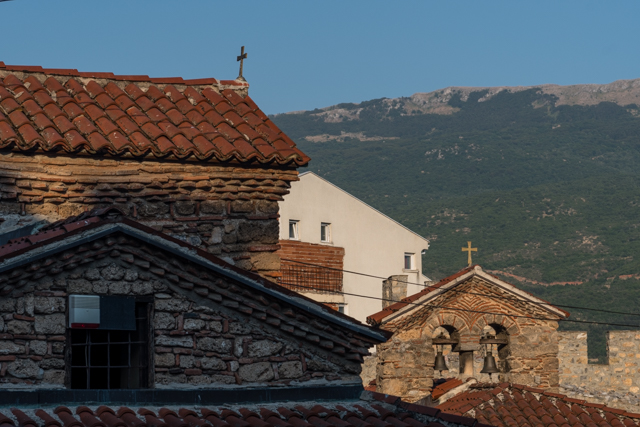
Next stop was at the Monastery of Saint Naum; the saint was responsible for a number of local miracles. The monastery was constructed by the Bulgarians in 905. The small church in the centre of the complex has three small rooms inside, these are all covered with beautiful frescoes. The iconostasis has a painting of the devil; very unusual in any churches anywhere.

After the Monastery we had lunch in a nearby restaurant – even the touristy places here are good quality and good value. We had a few salads and shared a spinach and feta pie.

There were water snakes swimming and basking around the rocks on edge of the lake, fortunately they only like shallow water.

We had one more swimming stop on the way back to Ohrid. The water was cooler there but the sun was warmer so it was still very refreshing. We were about a mile from the lakeshore; the sound of music from a hotel was loud even there.

I finished my book as we sailed back towards Ohrid – The Successor by Ismail Kadare; The book is a political thriller about the death of the nominated successor to the Communist Party of Albania; the leader is assumed to be Enver Hoxha but never named. Was the successor murdered or did he commit suicide? I highly recommend the book.

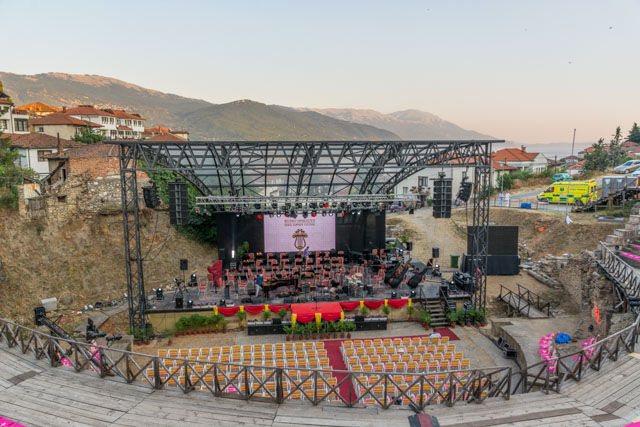
We had a quick stop to shower and change before heading out for the evening. We walked into the Old Town again, the history of the town is everywhere. The amphitheatre constructed by the Romans is currently being used as the main venue for the Ohrid festival. I visited the church of Saint Sofia, this large church was constructed almost 1100 years ago. Inside it has three aisles with columns in-between, much more open than the layouts at the monasteries we’ve been to.

We’d arranged to meet a couple of our travelling companions in a bar overlooking the lake for a pre-dinner drink, this quickly turned into three drinks. Florence and I had dinner on our own tonight, we found a nice place right by the water, and we were lucky to get a table with a view of St Jovan Kaneo church. Very nice food a Macedonian Pinot Noir to wash it down.

Tomorrow we return to Albania; we chose this trip primarily for Albania and Kosovo but Macedonia has been a revelation – highly recommended, come here soon!

It’s Orhid here

One of the major differences between this trip and Big Trip is the amount of socialising that happens. Lingering for a few drinks after an early dinner means that we end up having late nights – by the time we’ve written about the day and selected the photos to post, it’s really late.

We’re both tired today.

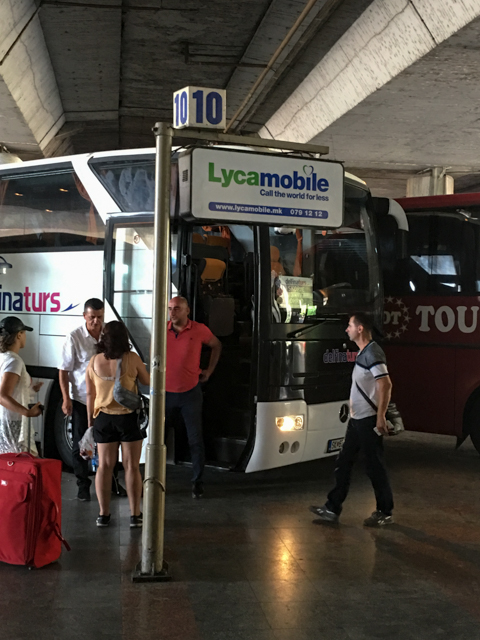
We left Skopje at 9:00am aboard a public bus to Ohrid.

Small towns and villages are scattered about; some buildings in the bigger towns reflecting that awesome Soviet brutalism style. Villages are nestled at the bottom of the mountain range.

Some of us drifted off to sleep (probably dreaming of the swimming opportunity ahead), but the vast majority chatted all the way. The only noise on board.

The journey took approximately 3.5 hours.

We saw storks nesting; storks on the ground, storks flying.

A village we passed through had a stork nest; and an Orthodox Church and a mosque in the background. I wasn’t sitting by the window today, so sadly I was unable to take photos.

A quick ‘technical’ stop saw the whole bus tracking down the facilities, and coffee and water for us.

Upon boarding the bus, I grabbed the window seat.

We travelled through a wooded area, the hills in the distance covered in trees. Huge infrastructure projects are underway – a new road; a new bridge and upgrading the road we’re travelling on (small delays incurring as a result).

We pulled in at a major bus station. I watched people buying tickets, chatting, saying goodbye to loved ones… a small window into other people’s lives.

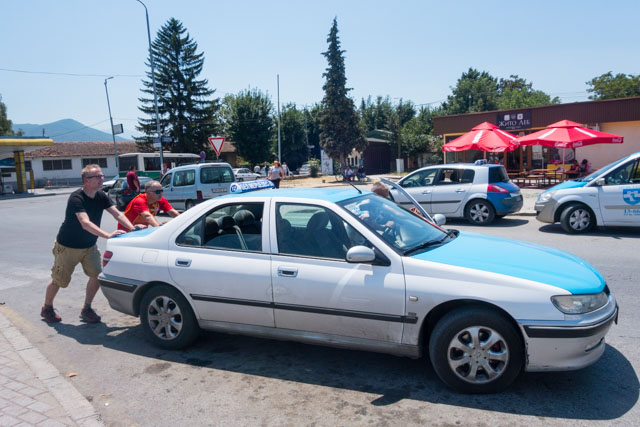
We arrived in Ohrid (pronounced something like ‘oh-ready) around 12:30pm. We got a taxi to the hotel. Well, we got in and then the taxi couldn’t start so Andy was asked to push start the car. In the heat. A hot car. Ah. Welcome to Ohrid!

Ohrid. We’d both wanted to come here for a long long time. It’s all in the name!

And also, it’s supposed to be pretty here. All Macedonians we’ve spoken to told us to come here. It’s a place they are proud of.

There used to be 365 churches here (one for each day of the year). I think we had one of these towns in Central America. A prize to the person who comes up with the name.

We dropped our bags into our room – beyond any kind of interior designer’s imagination… as in, almost kitsch but bad – and left for lunch.

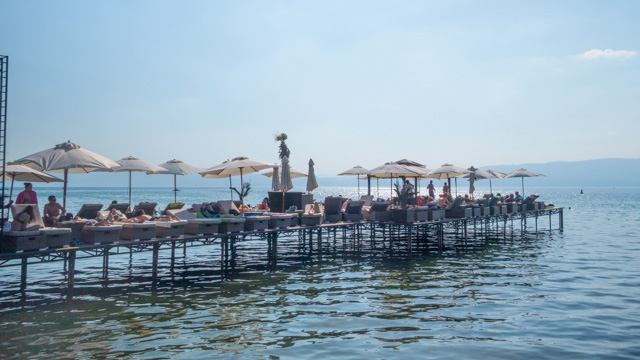
With the heat we’ve had throughout the trip, we’ve all been looking forward to the lake. We went to the coolest bar by the shore; scored great seats and dived in. The water was cool at first, but oh so pleasant. We had cocktails, Andy read his book, we chatted. Most relaxing.

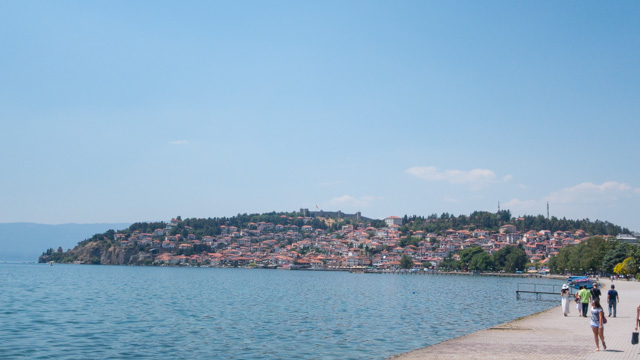
At 6pm, we were ready for our city tour. Orhid has a look and feel of a Mediterranean town. Cobbled streets, many churches; terraced bars. It’s busy but not crazy busy. Everyone here is having a nice time.

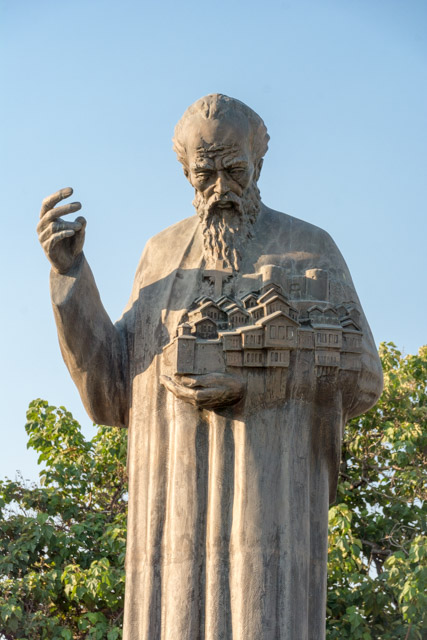
Our tour lasted two hours and it took us though all the major sites in town. As well as being an extremely popular summer destination, Ohrid has many claims to fame: a superb music festival yearly (tonight’s the opening night and the President of Macedonia’s in town); an Easter procession; the lake (as a summer destination) and of course (oh the things you learn!) Saint Clement of Ohrid who invented Cyrillic – now used by 250 million people.

It’s so pretty here – every corner is an opportunity to explore and photograph. Andy and I both got left behind by the tour. We have no idea what is what or why, but we had a great time and have cool photos! I’m seriously thinking we should come back for a week; there are so many back streets we’d love to explore further.

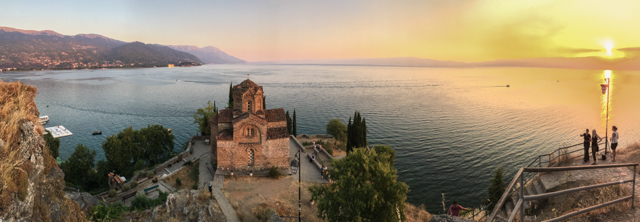
We did all end up at St Jovan Kaneo just in time for sunset. The church is picture pretty, and the sunset was vibrant. Its supposedly the most photographed building in Macedonia, it’s easy to see why.

A short walk back to town for dinner. Traditional food (which was delightful) and a break away from the wine drinking group tonight for me. I ordered a small bottle of red wine. It was divine. I let people try it and soon enough bottles of the stuff were ordered.

We walked back to our hotel (we’re about 15 minutes from the centre) along the busy promenade.

The place has a great vibe. We like it.

Ohrid is nice.

Feeling Hot Hot Hot!

Leisurely start this morning. The dining room is next to our room, nice buffet breakfast – terrible coffee. 9:00 we took some taxis for the twenty-minute ride to Matka Gorge. There is a bus but it runs every two hours, takes an hour and costs half the taxi fare so not an attractive prospect.

There are some churches and monasteries in the gorge. The oldest was built in 1389. They were once high above the river but the gorge was flooded by the construction of the Matka dam in 1938.

We took a small boat about 20 minutes up the valley to Vrelo caves. There is a huge difference in temperature between the heat of the sun outside and the damp cool air just a few steps inside the cave. The whole system carries on a long way underground; the full extent isn’t yet known but we saw two small lakes within the 70m or so that are accessible. There is a constant background noise of water dripping and the calls and flapping of a colony of bats on the roof. The caves have been used for classical music concerts recently; it must be quite an experience.

The boat trip back was into the breeze and a bit more pleasant. After the boat we had a look in the tiny St Andrew’s Monastery, the interior is only about 15 feet long but at least twice as high as that, it feels like a miniaturized version of the three large monasteries we‘ve seen before. The walls and ceilings are covered with biblical scenes, saints and the builder of the church, Andrijaš, son of a Serbian King. No photography allowed inside.

We stopped for a leisurely coffee, drink, cake etc, before taking taxis back to town. Four of us went straight to the Museum of Contemporary Art which was closed yesterday – we had better luck today. The collection was started in 1963 following a large earthquake in the city which destroyed a lot of older works. A number of galleries around the world lent or donated works to the gallery including Picasso, Jasper Johns and Barbra Hepworth. Today however none of these works were on show, the whole gallery was taken over by an exhibition of works by Petar Hadzi Boshkov, a Macedonian sculpture and painter who died in 2015. His work is often simple but very graphic and it feels like there are layers below the surface.

After the gallery, we walked back to the restaurant on the central square where we had lunch yesterday. We had another combination of salads which were very good and tried some of their beers too – between four of us we had sour cherry, strawberry and mint pilsners, all very refreshing.

Our lunchtime break prepared us for an afternoon of museums, starting with the Holocaust. The first thing you see is a sculpture consisting of electronic photo frames repeating pictures of Jewish families from Macedonia who were killed. The museum is on three floors, the central space across all floors has an art work consisting of 7,141 threads of beads – one for each Jewish person killed. They are all different but combine into a much greater whole. The exhibition tells the story of the migration of Jews across Europe following their expulsion from Spain in 1492. They found it hard to settle in Central Europe but were welcomed by the Ottoman Empire who valued their craftsmanship and commerce skills. One reason for the persecution of Jews in Western Europe postulated by the exhibition was that there was only Christian majority and any outsiders were always suspect. The Ottomans had always been an empire of many races and were therefore naturally more tolerant. After the migration, the upper floor concentrates on the events of World War 2. Macedonia had German forces to the south in Greece, Bulgarians to the east who at the time were sympathetic to the Nazis, and Italians fascists to the west in Albania. The Italians refused to join in the transporting of Jews to death camps in Poland thereby saving many lives.

After the history on the upper floors the ground floor has a number of paintings reacting to the Holocaust and a single Cattle Truck with its doors open, no explanation is given and none is needed, just looking inside to imagine how many people might have been crushed inside on the six day journey to Treblinka was enough.

Across the square is the Museum of the Macedonian Struggle for Statehood and Independence. Lonely Planet had warned us that there was a string degree of propaganda in the museum but we weren’t prepared for quite how much. You can only visit the museum with a guide. A tour had just started but we were allowed to join anyway. The museum couldn’t be better designed to disconcert you – all the rooms were very dark, walls and ceilings were predominately black, everywhere there were waxworks of significant figures from Macedonian history and large scale propaganda paintings. The Greeks, particularly the Clergy, the Bulgarians and the rest of Yugoslavia were all singled out for criticism. We had very little knowledge of the individuals or events being described, this left me feeling a bit underwhelmed by the museum. In a final surreal flourish the balcony above main entrance was filled with recognisable but fairly random figures – we could pick out Lenin, Stalin, Churchill, Eisenhower and Ataturk among many others. Unfortunately neither museum allowed photography inside.

We left the museum and headed for the nearby bazaar. The heat was now unbelievable; we thought it was one building reflecting the sun but it continued. We checked out a restaurant for dinner and had a short walk around the bazaar, retracing our steps from yesterday to the donut stall.

On the way back to the hotel we plotted a route to see a few mores sites – there’s a surprising amount to see here.

Mother Teresa was born in Skopje, her birthplace is marked by a simple stone plaque in a small garden, the house is no longer there. Skopje has its own Arc de Triomphe. Beyond that is the Monument to Fallen Heroes for Macedonia, this follows the ‘more is more’ style of the rest of the new city centre. North of the central square is a museum about Mother Teresa’s life – we didn’t have time to visit, nor did we have time for the Museum of Skopje, housed in the old railway station that was severely damaged in the 1963 earthquake. Our final stop was a statue of Tito, the man who somehow managed to unify Yugoslavia.

After a short break to cool down five of us headed out for dinner in the Old Bazaar. The restaurant is housed in a 15th Century Caravanserai – the food was traditional Macedonian, the wine was all local, very nice atmosphere, a very pleasant evening.

Skopje is a strange mixture of old and new, it has been fascinating, surprising and absorbing. A few more days here would be worthwhile but tomorrow we must move on.

Wonderfully weird Skopje

We left the hotel at 6:30am; we just had time for a quick breakfast – boiled egg, bread, and a good coffee.

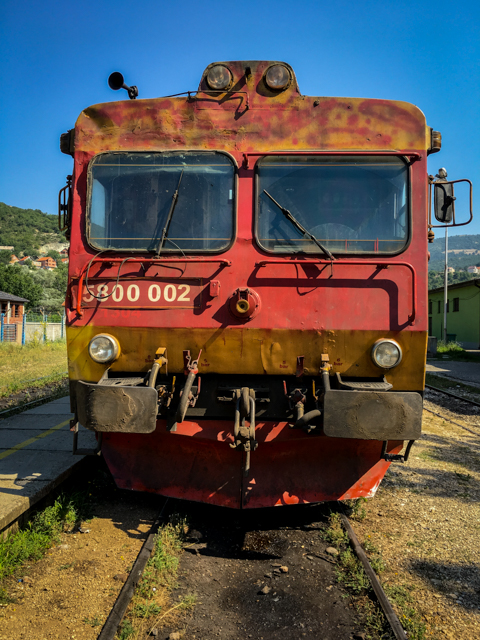
We got into taxis and headed to the railway station. One of the taxi drivers was puzzled when we told him we were getting the train to Skopje and said he could drive us there in an hour.

Ah. The romance of rail travel.

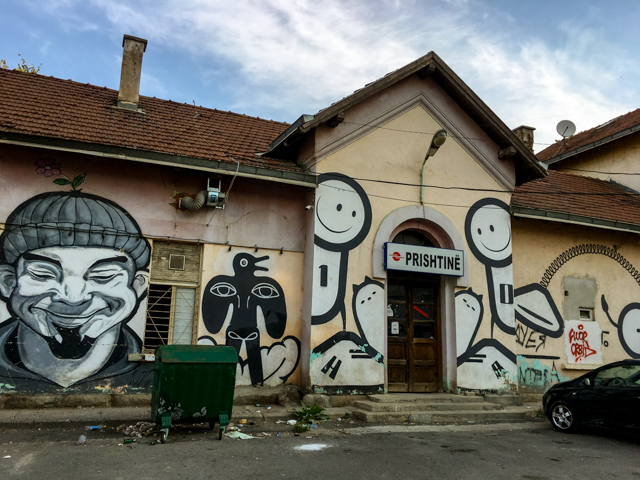
Ivan had told us that the station was something special. It was.

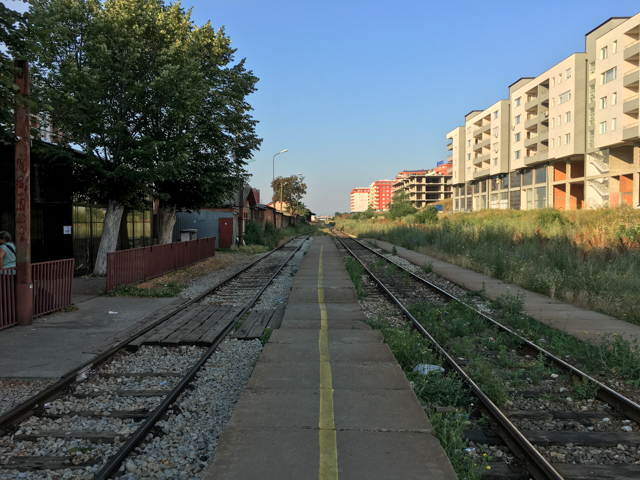
The decrepitude was an indication of the state of the railway and the many trains we would take today.

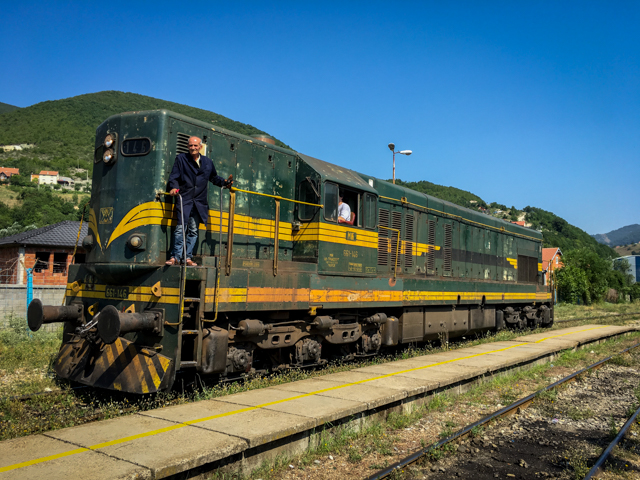
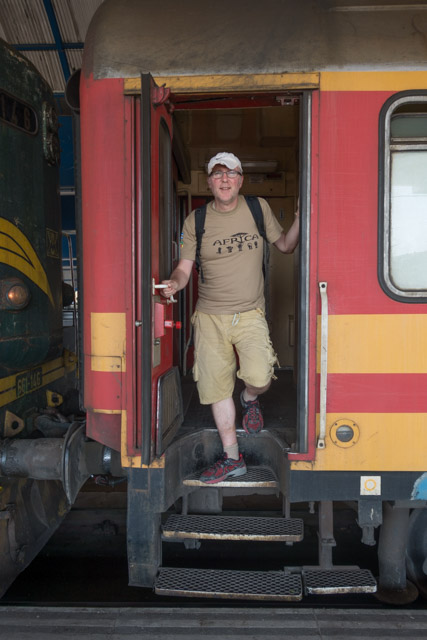
We boarded the train, the engine switched round and we were off. Two stations later – at Fushe Kosovo – we got off and boarded a smaller train. This one was more crowded.

Very quickly, the scenery became more rural but even then, houses scattered the landscape and you do feel that you’re never far from people.

Past Kacanik, a series of tunnels and bridges took us further into the hills. The train emptied, and there were only a handful of us left on board.

We followed streams. There are signs of progress in the distance – a new road, a new bridge.

The train was constantly blowing its whistle.

We stopped at Hani i Elezit and were told to get off the train. So we did. We used this opportunity to stretch our legs and use the bathroom.

A new Macedonian engine arrived after about 20 minutes. We boarded and departed.

Andy and I had our own cabin. We looked out of the window – very green – and read our books.

The only reason we knew we’d crossed the border is when the train stopped outside abandoned buildings which – a sign told us – were the border police. After 10 to 15 minutes, a police car arrived. The officer got on board, asked for our passports, got off the train and drove away. We all stayed on the train apart from two men who went into one of the buildings, got up on a desk and took two fluorescent tubes down and boarded the train again.

The officer came back after another 15 minutes or so. He handed all the passports and identity cards to a passenger who was having a cigarette and left.

That was all a bit funny.

At each station, I made sure to wave to the station masters – most waved back; one winked… and one was obviously too cool to acknowledge my wave.

We continued on to Skopje. As we got nearer, we could see the Millennium Cross on top of the hill. And a driving school where all the cars go round a course – a beginner’s off road driving course. Another funny thing.

As we got further into Macedonia, we really began to appreciate how poor Kosovo is. Everything is just a touch smarter in Macedonia.

When we got to the station, it felt like it was only us in what must have been at one time a huge busy intersection. Either that or the dream never realised. The platforms were all overgrown with weeds.

A quick taxi ride took us to our hotel. We checked in, handed the laundry in and left for lunch.

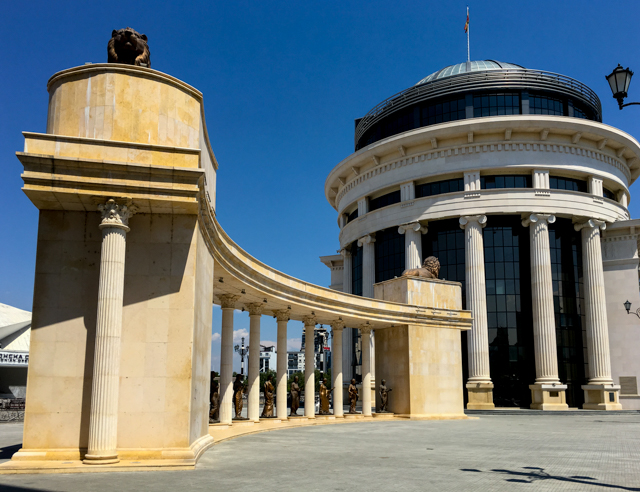
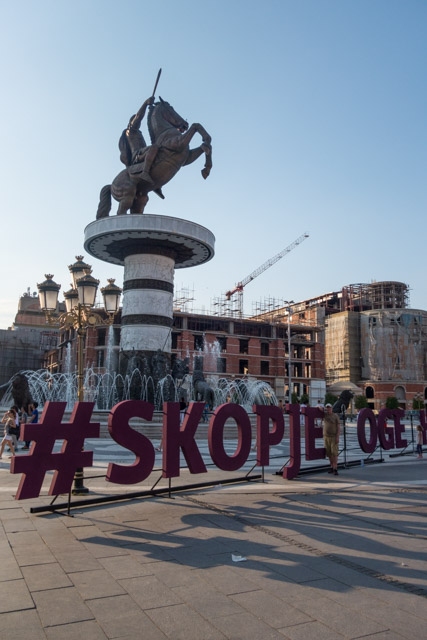
It’s about 15 minutes walk to the ‘centre’ of town. The first thing you see – and you cannot not see it – is a statue of Alexander the Great on Macedonia Square. It dominates the landscape, and we later found out it cost €35 millions. Crazy. Most Macedonians hate it. We also found out that the two lions at the end of one of the bridges cost €1 million each.

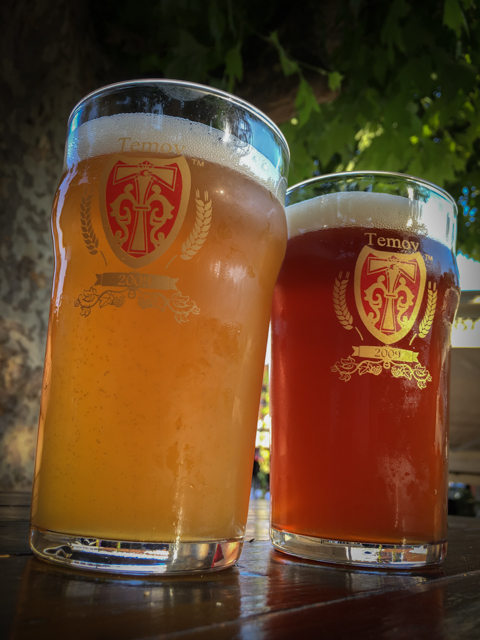
We had lunch on the square. We picked a branch of the first craft beer brewery in Macedonia – Temov. The food was excellent. We had tasty salads, and a traditional platter of cheese, garlic paste, bread, red pepper tapenade and olives. I tried a pilsner, and a smoked beer (my sample was almost as big as my beer!).

Getting going was tough. The temperature was well over 40c today, and shade was tricky to come by. But we knew we had to make the most of our day here so we soldiered on.

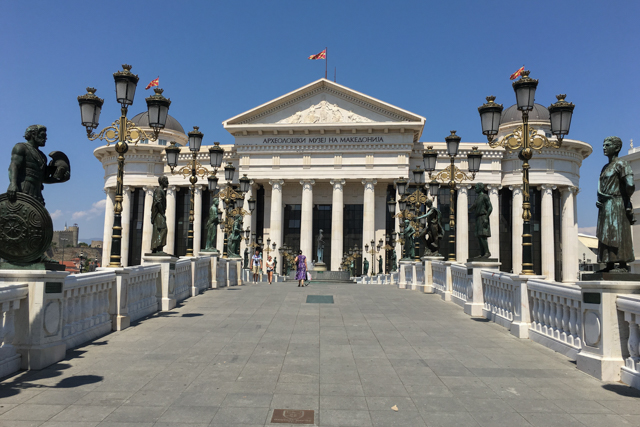
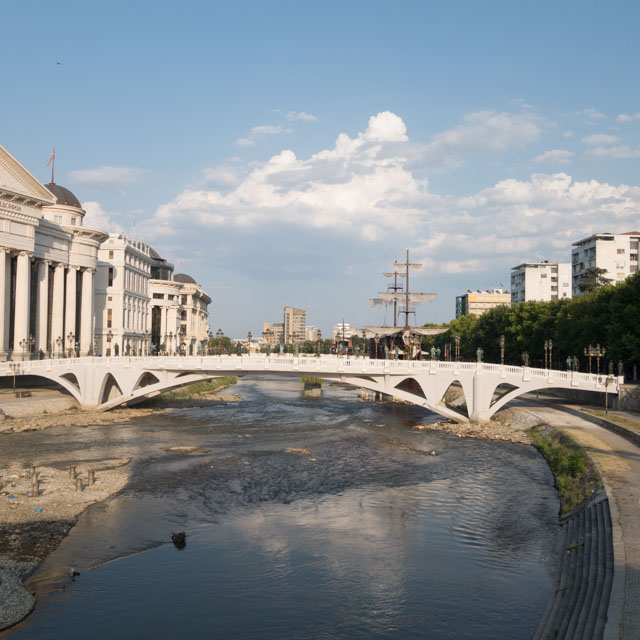
We walked along the river bank and crossed the Vardar river. The buildings on the other side of the river are insane. A modern ancient Rome is maybe the best description we can come up with. Andy’s going for ‘neo-classicism gone mad’. Ostentatious.

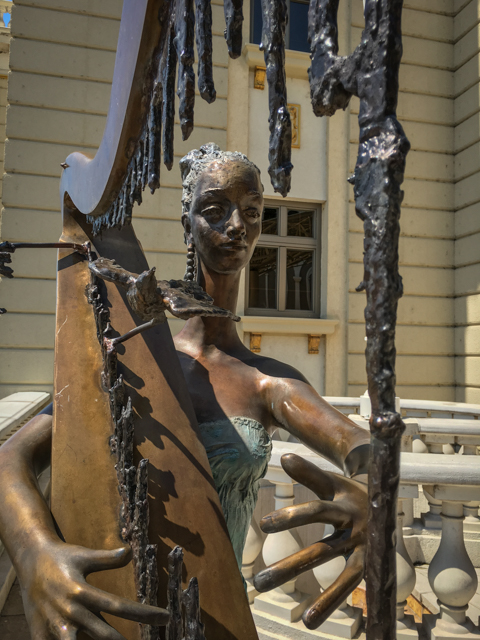
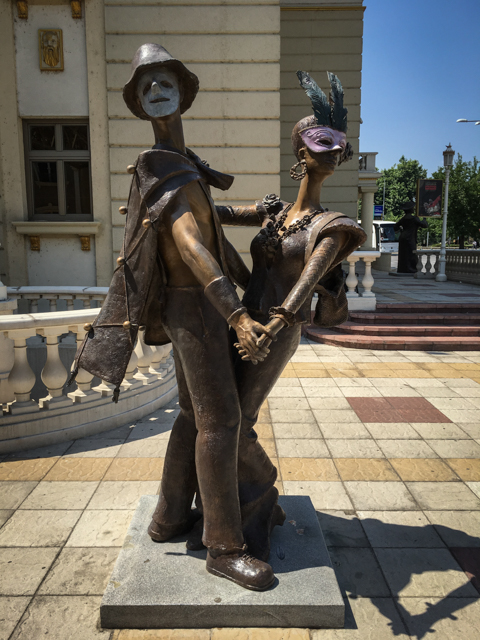
The other thing that struck us was the amount of statues and sculptures everywhere. Classical, historical, fun, tragic, arty. They’re everywhere. And as we crossed the bridge, I heard a noise. I turned to a local woman who was standing next to me and asked ‘music’. She replied ‘yes’. Classical music was playing in the street. When we passed by later on, it was Christmas music.

Three of us struggled up the hill. The heat was relentless. We made for the Contemporary Art Gallery but it’s Monday so it was shut. To the security guard’s dismay, we still went through the door and refilled our water bottles at the water cooler. Not wanting to waste a trip up the hill, we went to the fortress.

The fortress is the city’s highest point. It dates back to the 6th century AD, and underwent many changes throughout the years. It afforded us great views of the city, and in particular the national stadium.

Our travel companion started chatting to two young Turkish guys who were travelling. I noticed that they were carrying a musical instrument – a cumbus – and I asked them about it. One of them took it out, tuned it and started to play… and sing. It was a special moment.

We made our way to Čaršija (the Ottoman bazaar). A series of narrow streets – initially filled with tourist shops, and then further in with bars and cafés and then further on with local shops. We stopped for cold drinks and drank those quickly. We chatted some more, trying to gather the courage to stand up again. The local cafés furthest away were busy with men drinking coffee and playing dominos. We visited the big mosque on top of the hill. An older man inside delighted to see us waved us in. Back in the narrow street, I bought a syrup donut from a local woman, and it tasted heavenly. I tried to work out in my head how many more times I could ‘walk past’.

As the local mosques started the call to prayer, we made for a tea shop and had cold handmade lemonades.

Back on the main square, we met the rest of the group for a small orientation tour.

Dinner at Pelister was both fun (the company) and a little disappointing. It is the best restaurant in town, but the salads were not a success at our end of the table. We tried three different Macedonian white wines (taking our research seriously) and they were okay. I have a feeling that the reds would be better… but this is not red wine weather.

We had no expectations of Skopje. It turned out to be a fascinating, richly varied, historical and crazy place.

This Is My Truth, Tell Me Yours


We thought we had lots of time in Prizren but there always seems to be one more site to see. We got up early to tick one more off before breakfast. One of our travel companions had discovered a tiny church hidden away near the central square so we went to have a look. From the street there isn’t much to see but there are some steps down to the main entrance. Just as we went in a policeman – who should have been guarding it but was actually having a coffee across the street – arrived to tell us very politely we could take photos but please no Facebook. We could only just fit four of us in at the same time.

After breakfast, we left Prizren for the capital Prishtina just over an hour away. Not much to see on the journey. The roads were quiet, fortunately, as the driver spent a lot of the trip texting.

We checked into our hotel and popped into the convenience store opposite. It’s another hot day so an ice cream seemed like a good idea – I had a ‘chocolate bumm’!

Our excursion for the day started with a visit to the Field of Blackbirds, the site of the 1389 Battle of Kosovo. The Serbian armies were defeated (probably) by the superior forces of the Ottoman army. Although not strategically significant the battle has become very important to the history and identity of Serbia. A number of significant later events took place on the same date, including the assassination of Archduke Ferdinand by Gavrilo Princip in 1914 that precipitated World War One. There’s very little to see at the site other than a memorial erected in the Yugoslav era. We climbed to the top for an overview of the battlefield and the surrounding area.

Next stop was the grave of Sultan Murad or at least parts of him – his organs rest here, the rest of him is in Turkey. He was the Ottoman leader who was killed in the battle. We had a guided tour of the museum. It’s fair to say the guide’s version of the battle and subsequent events didn’t entirely match any other we’d heard.

After the grave, we headed for another old Serbian monastery. This one is in the town of Gračanica, a few miles away from Prishtina. The town is a small Serbian enclave. We passed a sign telling us we were now under video surveillance. Gračanica has the second largest Serbian population in the country behind Mitrovice. Shops take Serbian dinar, salaries are paid by the Serbian government and street names include Yuri Gagarin and Gavrilo Pricip.

The monastery walls are topped with razor wire. The church itself is again very beautiful inside. It’s very tall and has a unique double cross layout. The walls are covered with frescoes as usual. One wall depicts hell with people being eaten by beasts. Along the bottom of that wall are images warning people against specific sins: a miller who used false weights has a millstone around his neck for eternity; a woman who wouldn’t marry is devoured by a serpent and a blacksmith who worked on a Sunday is tortured by a red hot poker.

On the way to lunch we stopped at the best-known site in the city of Prishtina itself – a three-metre statue of Bill Clinton, at a major intersection on Bill Clinton Avenue. Next to it is a dress shop called Hillary, no mention of Monica nearby.

Lunch is on the edge of the city in Germia Country Park, a large park on the edge of the city. On the way we passed a huge swimming pool packed with locals cooling themselves. Lunch was okay but not very interesting food, more generic Italian than Balkan but this is where all city folks not at the swimming pool were today.

We took taxis back into town and had a quick walk around with our guide. Prishtina is a city of few sites – we saw a statue of Ibrahim Rugova (the first president of Kosovo), a Skanderberg statue and the ‘New Born’ letters.

After the group dispersed, we walked to the National Library. Built in 1986, this Brutalist edifice is an usually decorated building, the outside is covered in a decorative metal frame. On the way back to the hotel we tried to visit the Ethnographic museum but it was closed by then and looked like it hadn’t been open for a while. We walked back to the hotel through a local market that was closing up for the day, lots of fresh fruit and vegetables.

We had a few hours off, time to read and have a shower then joined some of the group for a glass of wine before dinner. We walked through an exhibit based around ideas of unity of all men with particular emphasis on the Balkans.

Dinner was in a cool place with good food, music and books. Soma Book Station is a vegetarian restaurant. It’s an all rounder: it starts the day with breakfast and coffee, moving through lunch and dinner until it becomes a late night club and bar.