Roaming the streets of Granada

It’s difficult to plan your day when you don’t know what’s going on. Initially, we were meant to leave Granada at 2pm today, and had the morning to ourselves to explore the town. This got brought forward to 12 noon, and then we were told we’d have a briefing at 11am.

We have breakfast in the hotel as the place we had in mind – with good organic Nicaraguan coffee – doesn’t open on Tuesdays. And then as we’re ready to go and explore, Dennis told us that the briefing is cancelled; we’re not moving on and will be in Granada all day. Oh.

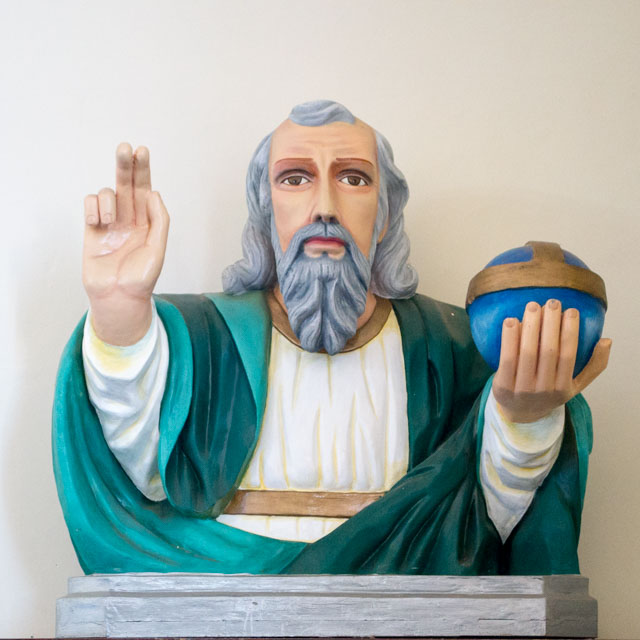
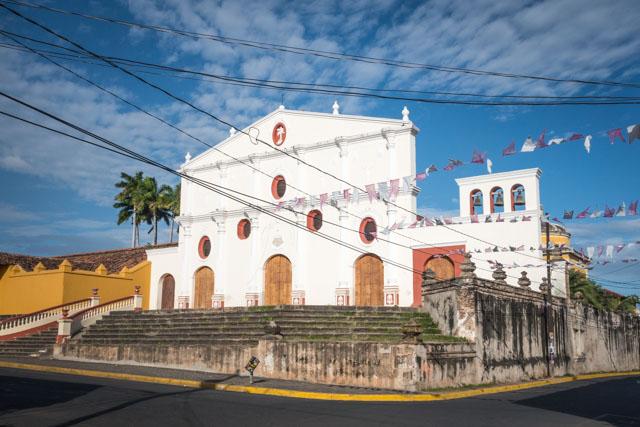
Our first excusion took us to La Merced church. As we admired the stunning facade of the church, a man passed us holding a squeaking piglet in each hand. The church is a lovely old building. We went in and came across some funny odd looking saints. We paid 30 cordobas each (about 84p each) and climbed a very narrow staircase to the roof which offered great views over the city. The wind up there was relentless, and we both held on to the railings a couple of times.

The wind… the very reason we are stuck in Granada for an extra night.

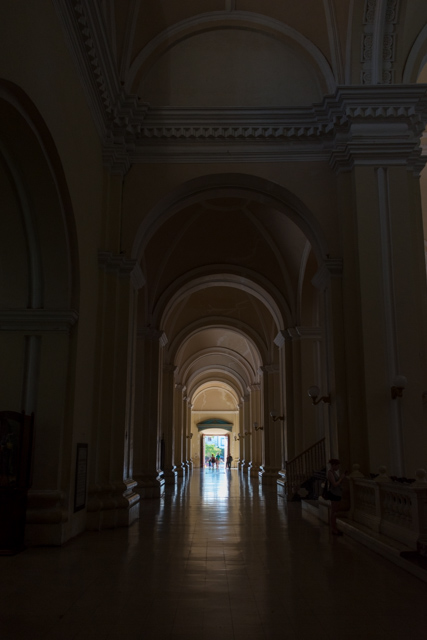
We moved on to the Central Square which we have been banned to visit at night for security reasons, and to the cathedral which is currently being renovated. The new murals are striking in their unusualness.

We headed back to our room briefly to put on lighter layers (we had dressed for an air-conditioned bus ride today, not sunny Granada).

I insisted on making a trip to the supermarket to buy some rum to take home. From there, it’s a small walk to the railway station via the Poets’ square. We paid a man 30 cordobas each and got access to an old engine, the former platforms and a few carriages (including the presidential one). Andy is a happy bunny.

We continued to the San Francisco church and former convent – now a museum. There are five strands to the museum and we take our time (there isn’t that much to do in town). The first patio is dedicated to religious festivals and folklore – all the descriptions of the ceremonies describe people roaming the streets. The next bit is a model of the city and we tried to work out what we have done and seen so far. We passed some wooden doors, presumably rescued from colonial buildings. Next, there are two rooms full of art from local artists – colourful naive style. Some depicting the gruesome history of Nicaragua. This is followed by religious artefacts and odd looking wooden representations of saints and Jesus. The explanation is that carving wasn’t a local skill until the Conquistadors came and trained locals in the art. The last part was reproductions of mesoamerican stonework, and some old pots. It’s a very odd museum. The good thing about it is the layout; it’s in the old convent so all the rooms face internal courtyards with palm trees and rocking chairs in the shade.

We stopped for lunch at the amazing Garden Cafe. We tucked into a fresh avocado, carrot and hummus sandwich and a tabbouleh and hummus wrap. Delicious. I ordered a mint lemonade and Andy got a machiatto (the best coffee he’s had in a long time). We’re about to go when we noticed a hummingbird darting about; we observed it for a while. They’re funny little things.

We explored a few more back streets on the way back to the hotel, peaking inside various art galleries.

We had cold drinks by the pool, wrote our diaries and waited for our 6pm briefing. The winds haven’t let off; our prospect for tomorrow is not great: we either stay another day in Granada (please no, we really struggled to fill our day today) or leave Nicaragua for Costa Rica a day early and forget about the Ometepe Islands (we were supposed to have two nights there, tonight being the first of these but the ferry’s cancelled due to the high wind). We’re still in the dark about our plans for tomorrow; our next briefing is 9am tomorrow.

Oh weather, why are you so hard on us?

It’s Getting Hot In Here

Today we’re promised the best day of the trip, at least this two week part of it – a bit of everything around Granada, we’ll see.

Tasty breakfast in the hotel, fruit granola and muesli for me, omelette for Florence who is now 90% recovered from yesterday.

Leave the hotel at 9:00, first stop is the supermarket three minutes later, not sure why so we stay on the bus. Next is the old railway station, this is now a business school but an old steam engine and a couple of carriages remain. Students at the school get most of their fees paid as long as they do community service in the local area for 6 months after graduation.

Granada is on the edge of Lake Nicaragua, the second largest lake in Latin America behind Lake Titikaka. Our next activity is a boat trip on the lake. There are many islands around the edge, some occupied by very poor communities who subsist on what they can catch in the lake and some occupied by luxury houses costing hundreds of thousands. There are many birds and a few monkeys around too.

We stop briefly at the main cemetery – Central America’s oldest and the resting place of six former presidents of Nicaragua. The graves are all mausoleums above ground because of flooding in the area, there is no cremation here. One area is called the boneyard, this is where the remains of people who couldn’t afford a grave were left.

We leave the town behind and head for Laguna de Apoyo, a crater lake in a volcano which last erupted 26,000 years ago. The panoramic view across the crater is spectacular. We move on to a resort on the lake shore, we have over three hours here. This feels too long after we’ve been rushed between sites all morning.

Drink a few cups of coffee, have some lunch, write a few pages of our diaries and watch the comings and goings on the lake and the time passes quickly enough. The resort has a couple of resident green parrots who are very entertaining, they seem to be endlessly bickering like an old married couple.

Stop at a handicraft market, it’s dark inside – we’re told that the whole of Central America is suffering a power cut because of trees falling on some cables in Honduras; this seems entirely plausible.

Final stop, and the highlight by a long way is visit to Masaya Volcano. I’d like to say we hiked for hours to reach the edge of the crater but actually this is one of the few, if not the only active volcano where there’s a road to the edge of the crater. We queue for a while on the main road, there’s a maximum of 60 people allowed at the top at any one time and we’re only allowed fifteen minutes on the crater edge.

Seeing an active volcano has long been on my list of things to do; this was an unexpected surprise here. It’s an incredible site, 70m below us the glowing red lava bubbles and moves around, above it there are clouds of steam and smoke swirling around, lit by the fiery glow from the crater. Fifteen minutes pass in whats feels like seconds – a definite highlight of our trip.

How do you follow that?

When we’re back on the bus our guide Ramon breaks out a gallon container of Macua, the national drink of Nicaragua, a cocktail of rum, guava, lemon and other fruit juices, puts on a party mix from his phone and puts on some flashing lights on the bus. The journey back to the hotel is a surreal mixture of AC\DC, Justin Timberlake and Britney, people are dancing in the aisle. When we pull up outside the hotel there’s still some cocktail left so we convince the driver to drive round a few blocks until it was all gone.

Es Verdad Sandinista

Early night again – we know how to party – so we’re up early. Florence is feeling a bit under the weather so I’m on my own this morning. Go out in search of breakfast but it’s Sunday and nothing is open yet, grab a snack – scrambled eggs, rice and beans – and a coffee in the hotel then meet Henry my guide for a walk around Leon.

Henry starts by telling me that the market next to the hotel is the Mercado Estacion because it’s where the station for train from Managua used to be. The railways became more and more run down during the first half of the last century until the government decided they were too expensive to repair and closed them. Leon streets do have names but nobody uses them, our map has no street names and there are almost no street signs, the locals navigate using churches or other landmarks. One exception is Calle Juan Pablo, named to commemorate the two visits of the former Pope to Leon.

Henry explains that the Nicaraguan diet is generally made up of heavy, starchy food like potatoes, casava and corn – he is a testament to this. We walk through another market, there are tamales – stuffed corn husks or banana leaves – cooking in a vat of dark bubbling liquid, not very appetising to me but he is impressed.

First proper stop is the Heroes and Martyrs monument to those killed by government forces during the revolution. Behind the monument a large mural tells the story of the country from the early meso-americans through the conquistadors, independence from Spain and then Mexico, a letter from the assasin of Anastasio Somoza García, to his mother and the revolution. Every scene shows death, war and destruction. After all this, it finishes with an idealistically upbeat image of two children playing in sylvan surroundings by a lake.

The Sandinista National Liberation Front – FSLN – now a socialist political party took their name from Augusto César Sandino, the leader of the rebellion against the USA backed government of the Somoza dynasty in the early 20th Century. Their red and black flag was adopted after it was used by protestors against the massacre of a number of students; it represented blood and death. The Sandinista played a larger part in the overthrow of the Somoza government in 1979 and assumed power soon afterwards. The stayed in power until 1990 despite the Contras, a right-wing counter revolutionary force backed by Reagan’s USA trying to destabilise them. Daniel Ortega, a former revolutionary leader and prisoner of the Somoza regime was president from 1979 to 1990 and again from 2006 to the present. A fact for the rock-trivia fans – The Clash album Sandinista has the catalogue number FSLN1.

Next stop is Prison 21 – opened in 1921 by the Somoza government and liberated during the revolution. It’s now a museum, there’s a photo in the entrance of a tank on the street outside with a rabble of revolutionaries. The tank is also in the museum – it was second hand from Russia and must have been 30 years old when it arrived. The museum is a strange blend of the horrors of the conditions and the torture prisoners underwent along with a number of almost grotesque figures depicting folkloric tales. The tortures are graphically illustrated on the prison walls, a cell not much bigger than our hotel room held 50 prisoners. The folklore tales include the ‘Headless Priest’, the ‘Pig Witch Woman’ and ‘Grab My Tit Woman’.

Final stop is the art museum. This has grown from the private collection of one of Leon’s wealthiest families, they bought a large house to hold it then had to buy another larger one opposite to hold more. It would take most of a day to do it all justice. There are many highlights from Central American artists I know nothing of along with better known European artists including Braque, Picasso, Sonia Delauney and Henry Moore.

Head back to the hotel to revive Florence and get our bags ready to depart for our next stop, Granada. It’s a two and a half hour drive, the countryside is initially hilly, dry and barren. When we pass the capital, Managua, it becomes flatter and more built up. It seems to be a quirk of this trip that we never visit capital cities, Mexico City is the only one so far.


Breakdown of an eight hour journey

4.10am. The alarm goes off. Cold showers. We finish packing and make our way to our private bus. An extra two people board our bus – a couple travelling ‘independently’ and who clearly haven’t done their research. We voted to decide whether to give them a lift all the way; free ride! We leave at 5:06am. You wouldn’t know how early it is considering the loud chit-chat going on. The journey takes under an hour. Our last moments in El Salvador; a country we knew little about and an unexpected highlight of the trip so far.

6:14am. ‘Technical stop’ at a petrol station. We drive a little further to the immigration office. Dennis goes off with our passports. There is an issue with one of the guys in our group; he has a fairly common name and there is someone with that name working illegally in Guatemala, so he goes in with extra identification papers. Eventually, we’re free to go and continue on to the ferry ‘terminal’.

7.19am. We walk along the pontoon with our bags, board our boat and put on our life jackets. We have a two-hour boat ride ahead of us. It is pretty uneventful until we stop almost half way through to look at some rocks in the distance. This is where El Salvador, Honduras and Nicaragua meet. Fishermen in dug-out canoes. Gulls diving in for fish. Small islands with even smaller communities on them.

9:10am. We land in Potosi. This is a wet landing; it’s less than a metre to land, but the water is full of jellyfish. We collect our bags and await the signal from border control before loading them into the bus. This is a tiny border crossing and until recently, they were left alone. But Intrepid recently changed the trip itinerary, and every two weeks or so, they have a whole bus-load to process. We have to be on our best behaviour, and after an hour or so, we’re in. Welcome to Nicaragua!

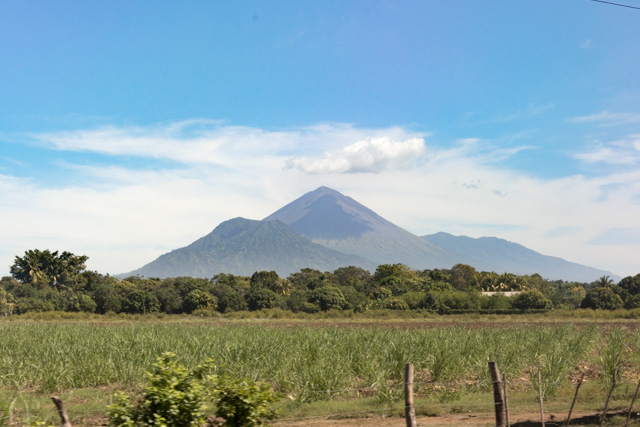
10.19am. We’re on the road. It is extremely rural. The tarmac road is bumpy, and covered in sandy dust. In the distance, we see a smoking volcano. We turn on to NIC-12. The road is instantly much better.

11.14am. We pass small communities. All river beds are more or less dried up. When they’re not, there’s only a small trickle of water which is either full of rubbish or looking contaminated. Later on, we pass communities with signs with a blue and white logo I recognise well.

12.27pm. We make a ‘technical’ stop in Chinandega. We get out of the bus and the heat hits us. The final stretch. We’re on the Pan-American Highway. We pass big agricultural fields. With less trees by the side of the road, we have open views for once. The traffic slows us down but we arrive in León in time for lunch. It is 34c. No breeze, no humidity, just pure heat. I have a feeling that the little chap with the moustache above is a celebrity; as a stereotype Central American man, I guess the products he advertises appeal to the masses.

We’re both excited to be in León. The first impressions are good. The town has awe-inspiring churches, is renowned for its culture, has an edgy feel and all this against a background of crumbling colonial buildings.

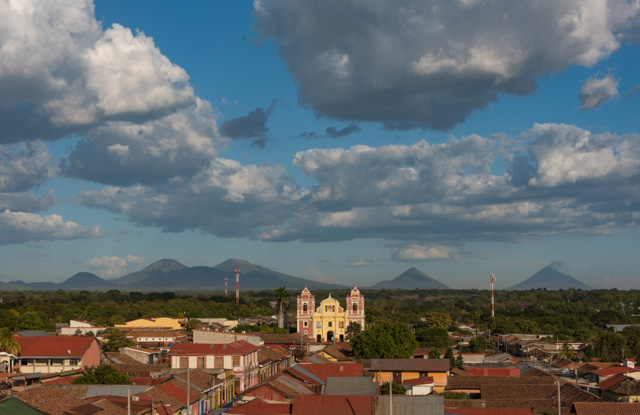
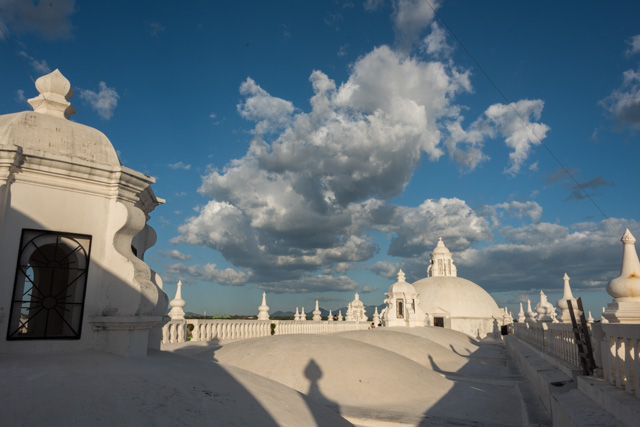
We walk the streets, randomly at first, and then go in the Cathedral. It is the largest cathedral in Central America and is one of Nicaragua’s cultural landmarks. We go round the building until we find the ticket office, pay $3 each and walk all the way round again until we find a small door, and make our way up to the roof. We’re told to take our shoes off, and not to walk on the domes or we’ll go straight through. We’re also told not to climb on the railings. We witnessed a youth doing so, and promptly being escorted out by the guards, along with his mates (they were told off for not stopping him). We’re rewarded with bird’s eye views of the town, and the surrounding countryside.

We come across the martyr monument, the poets’ square and the museum of the revolution – all this we’ll explore in detail tomorrow. We also come across the Church of la Recolección which looks stunning with the late afternoon sun glowing on it.

6pm. Back to our hotel for a rest and to read up about the Sandinista National Liberation Front, as this is what tomorrow morning is all about.