


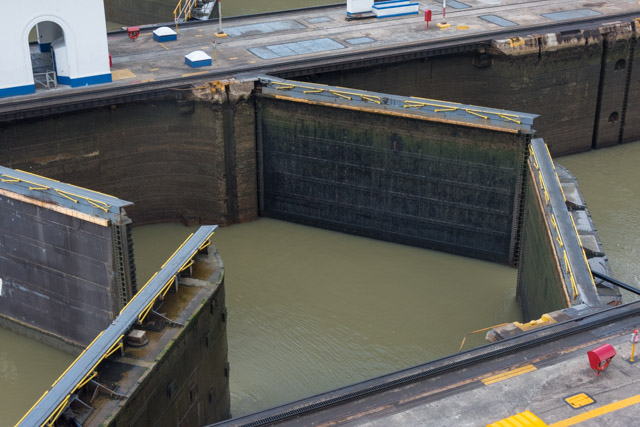

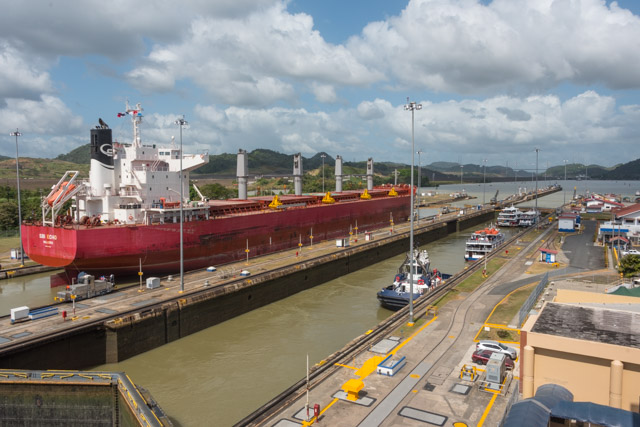







 Today is all about the canal – four of us set off in a taxi at 9:30 to go to the visitors centre on the edge of the city. It’s about 15 minutes drive from the hotel. The centre overlooks Miraflores Lock, the first lock that take ships up from sea level. The majority of the canal is about 25m above sea level because it was created by flooding a valley to create a lake which forms the northern half of the route, this had to be higher to make it big enough and deep enough.
The Spanish conquerors had been investigating better ways to move goods across the isthmus of Panama since the 1540s, the majority of silver, gold and other goods they took from South America came through this area. Many plans were put forward over time. The Panama Railway was built in 1855, this is still in use and largely defined the canal route. The French started work on the canal in 1881, work continued until 1894 when the company ran out of money. The terrain had proved more difficult than expected and 25,000 workers from France and the Caribbean lost their lives. In a clever piece of political manoeuvring, Panama got help from the U.S. to gain its independence from Colombia. At the same time the U.S. bought out the French company and agreed to compete the canal; the first ship passed through the canal in 1914. This didn’t come for free however and the U.S. was granted control over the canal and the immediate surroundings along with the lion’s share of the income. This continued until growing unrest in the sixties and seventies led to President Carter in 1977 agreeing to hand over full control to Panama in 1999.
The canal is now one of the major sources of income for the country, up to 25 ships a day pass through, charges are as high as $500,000 – estimated income is $3bn per annum. Because of the increase in sea traffic globally, the increase and the size of shipping and the threat of a Chinese-backed canal through Nicaragua it was agreed by a referendum in 2007 to spend $5bn on increasing the capacity of the canal. The new locks and channels opened in mid-2016, these allow for all but the very largest vessels to pass through.
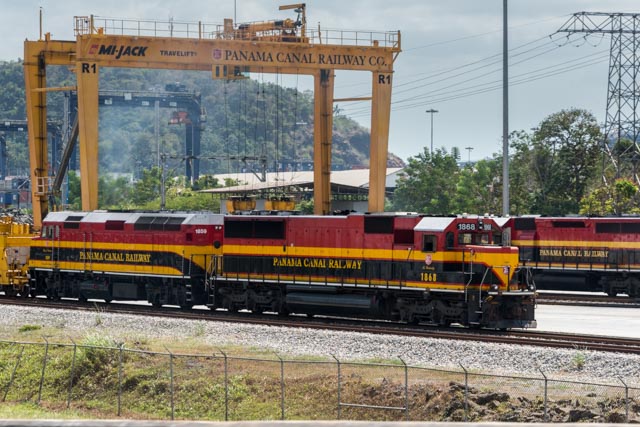
Soon after we arrive a cargo ship is on its way into the locks from the Pacific, all traffic goes this way before midday and the opposite later. The canal operates 24 hours per day. We rush to the top floor and found a good vantage point, the railings are already crowded with spectators. The ship is eased into position by six diesel locomotives, three on each side of the lock. The captain of any vessel has to hand over command to a Panamanian pilot to pass through the locks. The gates close and the vessel almost imperceptibly starts to rise, it looks like it’s empty as it floats very high in the water. After about 10 minutes, the lock is full and the engines ease the ship forward and into the canal itself. There are tug boats wait to pull it forward to the next lock a mile upstream. All of these locks are operating in exactly the way they were designed and built 100 years ago, an impressive feat. The visitors centre has a film, a museum and of course a gift shop – but first it’s coffee time. The coffee is from the producers in Boquete we recently stayed with – very good it is. There’s a plaque on the wall outside the cafe presented by the UK Government on the centenary of the opening in commemorating the British West Indians who worked on the canal. The film is massive PR promotion for the canal – would you believe no environmental damage was done by the recent $5bn project? We spend 3 hours at the centre, ships are queuing up to enter the locks from the North when we leave, we could easily have spent a few more hours watching them but our taxi is waiting.
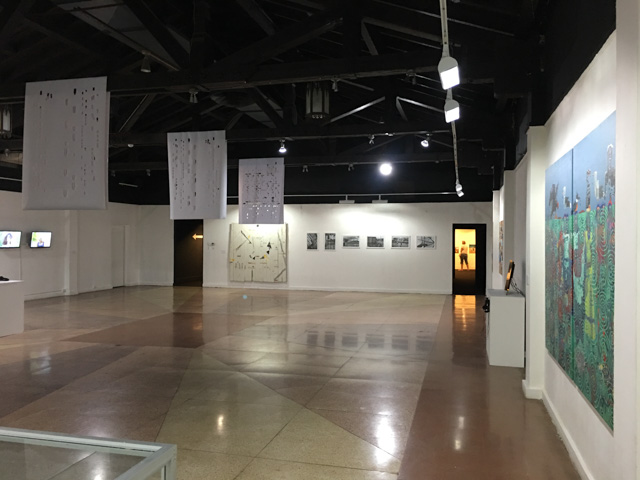
After the canal we head to the Museum of Contemporary Art, to shorten the walk we take a ride on the Metro. It’s very clean and efficient and costs 35 cents a journey. The Museum has an exhibition by a Panamanian artist David Solís on the ground floor. He has lived and worked in France for many years and this is one of his first major exhibitions in his home country. His work is interesting but doesn’t grab us too much, the same themes seem to repeat many times. The first floor has everything you expect from a Contemporary Art Gallery: obscure video works, bad photos masquerading as art, garish paintings, 3d works made from paper and a sound installation. It’s all interesting without any of it being really absorbing.
Take another metro one stop to the Albrook Shopping Mall – I need some new shoes – have to look good for Tahiti! It’s intimidating in its size, we look in a few shops and finally find an outdoor store. They have what I want but not in my size. Just time for a juice and snack before we return to the Hotel.
We’re off to the San Blas Islands very early tomorrow morning. Just like in Santa Catalina, we won’t have any internet access so we’ll post retrospectively on our return to Panana City.
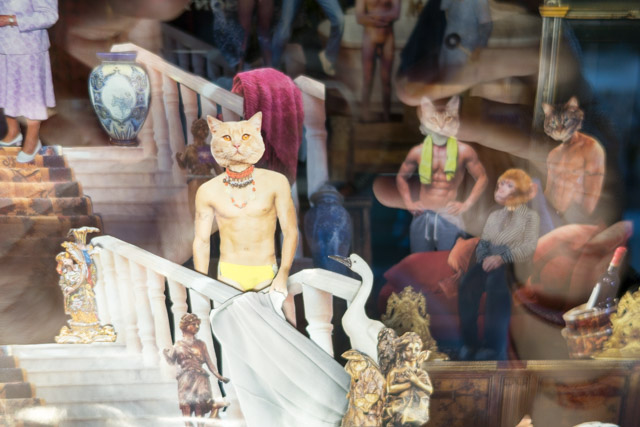
Glad to see some train pictures. Are the ripped men with cat heads the work of David Solis? They looked cool. And why has Chris not commented for two days? Is he poorly?
The ripped cat-men are by Pilar Moreno – looks like a bit of a theme of hers.
Johnson is back and firing on all cylinders, phew.
Incredible those little train tugs. I’d never have guessed that. Great photos and narrative.
Hi Andy, the new canal is it far from the previous ? No pictures of the new one ? Great photos as usual.
Bonjour, it’s next to the ‘old’ canal but further away from the visitors’ centre so it isn’t very easy to see, you can just see the control tower. Google maps shows it well.