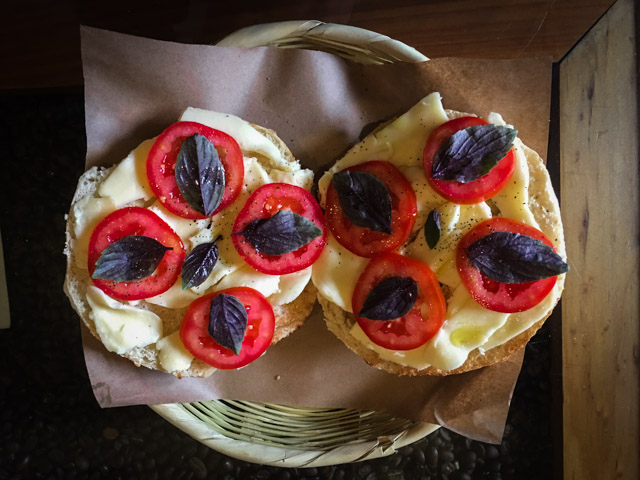
Hit the streets of La Fortuna at 7:30 in search of breakfast, easy to find as we’re going to the same place as yesterday. This time I have a bowl of fruit and yogurt. We’ve got an hour before departure time so we have time to try out the best coffee in town – a claim made by Down to Earth Coffee and backed up by TripAdvisor. My cortado is very good, Florence’s latte is a bit too milky.
We’re leaving at 9:00 for the capital San Jose. Due to a quirk of our itinerary this is the first capital we’ll stay in since Mexico City. The journey begins with a long climb through green hills, we pass over a number of rivers in deep wooded valleys. Once we reach the hilltops the views are spectacular, the sky is light cloud, the sun occasionally breaks through to highlight a part of the landscape.
Unfortunately this can’t last and the scenery soon flattens out and becomes more built up. San Jose is a modern built up city of 300,000 inhabitants. This is a bit of shock, we haven’t been anywhere like this since we left Mexico. The hotel is about a mile from the city centre in a nice leafy suburb, just time to drop our bags and head out for our orientation walk. There’s a long pedestrianised street in the centre, this has multiple McDonalds, Starbucks and American trainer outlets. We’re warned to be careful of our belongings and left to explore.
First stop is the Cathedral. Built in 1850, it’s not particularly attractive inside or out. Stop for a quick drink and share a sandwich at the National Theatre cafe, inside this building could be any West End theatre.
Our next stop is one of the highlights of San Jose – the Gold Museum. This museum displays many pieces from pre-Columbian Costa Rica and also explains the background to the society of the time. There were many settlements which traded with other early American peoples from as far away as modern day Mexico and Bolivia. There were however no large cities or buildings like those further north.
The exhibition explains how gold working developed first around 1500bc in the Andes and slowly spread north, each area had its own techniques and designs. The museum has hundreds of gold pieces of all shapes. Not surprisingly security is tight, we’re warned not to photograph the security guards, any baseball caps must be warn backwards – presumably so faces are clear on CCTV.
Walking back to the hotel we notice the walls of what is now the Costa Rica National Museum are full of bullet holes. This was built as a Fort in 1917, the bullets holes are from the civil war of 1948. This lasted 44 days and accounted for over 2,000 lives. It started when the election results were anulled by the government alleging the opposition had won through fraud. A military junta overthrew the government and ran the country for 18 months, disbanding the armed services and introducing a new constitution and elected assembly.
We’d noticed some railway lines down the middle of the main road near the hotel earlier, they were shiny indicating a regular service. We found out why – a noisy old diesel engine chugged up the street blaring its horn, pulling three dusty old carriages. This stops the traffic while it passes. Having been back at the hotel for an hour it seems to be a regular service, hopefully it doesn’t start too early in the morning.